National Central University-College of Engineering
Implementation Summary of the Program on Bilingual Education for Students in National Central University College of Engineering
The College combines and leverages resources at the university and collegiate levels to promote bilingualism. The implementation overview for the 2022-2023 academic year is stated as follows.
1.Features of the program on bilingual education for students in National Central University
(1)University-level “Bilingual Teaching Promotion Resource Center”: Regular meetings are held with departments, institutes, and relevant administrative offices. To these meetings, bilingual learning experts, scholars, as well as leaders from the industry, government, and academic sectors are invited to participate in the Advisory Committee. The aim of these meetings is to offer suggestions and foster consensus on promoting English-taught courses and enhancing students' English proficiency. Additionally, they focus on dynamically adjusting strategies for the plan's execution to ensure both its effectiveness and the quality of implementation.
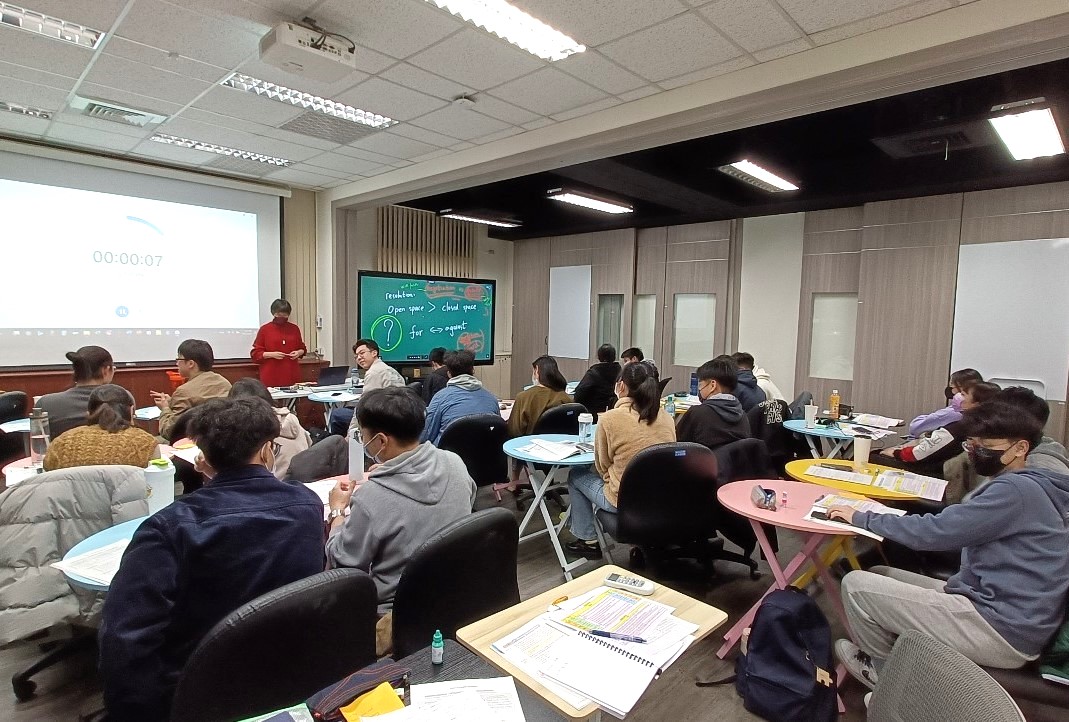
(2)Planning of EAP and ESP Courses: Aligned with the College's needs and based on the students' English proficiency, English for Academic Purpose (EAP) and English for Specific Purposes (ESP) courses are developed. Courses such as “Technological English Presentation and Briefing” and “Engineering English Reading and Oral Expression” are specifically designed to enhance students' English abilities and facilitate their transition to EMI (English as a Medium of Instruction) courses.
2.Features of the program on bilingual education for students in the College of Engineering
(1)College-Level Bilingual Promotion Committee: Meetings are held each semester to discuss the implementation and current status of bilingual-related rewards for teachers and students. Additionally, the committee conducts an annual review of the bilingual program and plans for its future direction.
(2)Enhancement of the EMI Website for the College of Engineering: Continuous enrichment of the EMI information platform is undertaken. By providing a blueprint for bilingual learning and EMI teaching, we aim to enhance the understanding of EMI among teachers and students. The website not only offers basic information about EMI, evaluation methods, and academic extracurricular support, but also continuously updates EMI-related activities to improve the accessibility of EMI information for teachers and students.
(3)Exclusive Surveys for EMI Courses: At the end of each semester, surveys are distributed to students and teachers to understand the challenges, needs, and teaching effectiveness they experience in the courses. To increase the response rate, the College organizes a drawing activity, encouraging students to participate actively. The survey results are then compiled and presented to the teachers as a reference for course design, aiming to further improve the teaching quality of EMI courses.
(4)Diverse Range of EMI Courses: In the 2022-2023 academic year, a total of 125 EMI courses were offered by the College, providing a wide range of course options for students in various fields. The proportion of sophomores and first-year master's students taking over 20% of their credits in EMI courses was as high as 38% and 82%, respectively. Through the bilingual program's incentive mechanism, the College encourages more students to actively participate in EMI learning.
(5)FOR Teacher
A. Implementing the Incentive Regulation for EMI Courses at the College of Engineering: In addition to the subsidies under the university’s “English Teaching Incentive Measures for Teachers”, an extra reward of NT$6,000 per credit is offered. Additionally, support is provided for one teaching assistant for each compulsory EMI course at the undergraduate level, along with funding for developing online EMI courses. The objective is to encourage and facilitate faculty engagement in EMI teaching.
B. Organizing EMI Teaching Observation Activities: During the 2022-2023 academic year, we invited Prof. Sammy Lap Ip Chan from the Department of Chemical and Materials Engineering, recognized as a model EMI course teacher at the college, to lead two EMI teaching observation sessions. Six teachers participated in these activities, reporting considerable benefits. These sessions not only broadened their horizons in teaching EMI courses but also provided deeper insights into effective EMI teaching strategies. The participants unanimously found the EMI course observation activities to be extremely valuable and recommended their continuation.
C. Enhancing EMI Teaching Capabilities: In partnership with Fulbright Taiwan, we organized nearly ten practical and diverse EMI teaching and TA training workshops. These workshops offered teachers and TAs the opportunity to learn innovative EMI teaching strategies and to share their experiences and skills in EMI teaching. Additionally, during the winter vacation, ten faculty and staff members from our university participated in a 14-day cross-cultural EMI teaching observation and exchange program at the University of California, San Diego, named “2023 Fulbright EMI Overseas Professional Teacher Training”. Following the program, the participants disseminated new insights on flipped classroom methodologies and various EMI course designs.
(7) For students:
A. Implementing the 'Bilingual Program Incentive Measures for Students in the College of Engineering': In order to cultivate bilingual professionals in the field of engineering and enhance students' English abilities, thereby laying a foundation for learning in English, we have established specific incentive measures for students participating in the bilingual program. These measures are categorized into two types: the first type targets students who achieve the CEFR B2 standard in English proficiency; the second type is for those who meet the E1 to E5 standards through their participation in EMI courses.
B. Offering English Proficiency Enhancement Courses: The College of Engineering has collaborated with teachers from the Language Center to provide courses such as 'Effective Speaking & Writing Made Easy' and 'Key Business Communication Skills'. These courses are designed to strengthen students' oral and written communication abilities, as well as to help them master a variety of business English communication skills, including business letter writing, presentation techniques, and interview skills. This initiative aims to enhance their competitiveness in their future careers.
C. Creating a Platform for English Presentation Performance: To encourage students to develop their skills in English, events such as the 'English Presentation Contest for Science & Technology' and 'Capstone Project Presentation Conferences' are organized. These events motivate students to create posters, presentations, and oral reports in English. As an incentive, extra credits are awarded. This initiative provides students at the College of Engineering with valuable opportunities to learn from each other and to showcase their project achievements.
D. Holding Student Discussion Sessions: Organized every semester, these sessions aim to promote bilingual incentives, community support measures, English proficiency enhancement courses, and various other student-related bilingual activities. The objective is to enhance student engagement in bilingual activities, deepen their understanding of EMI, and gather suggestions for advancing the bilingualization of departments and college.
E. Organizing Student Lectures:
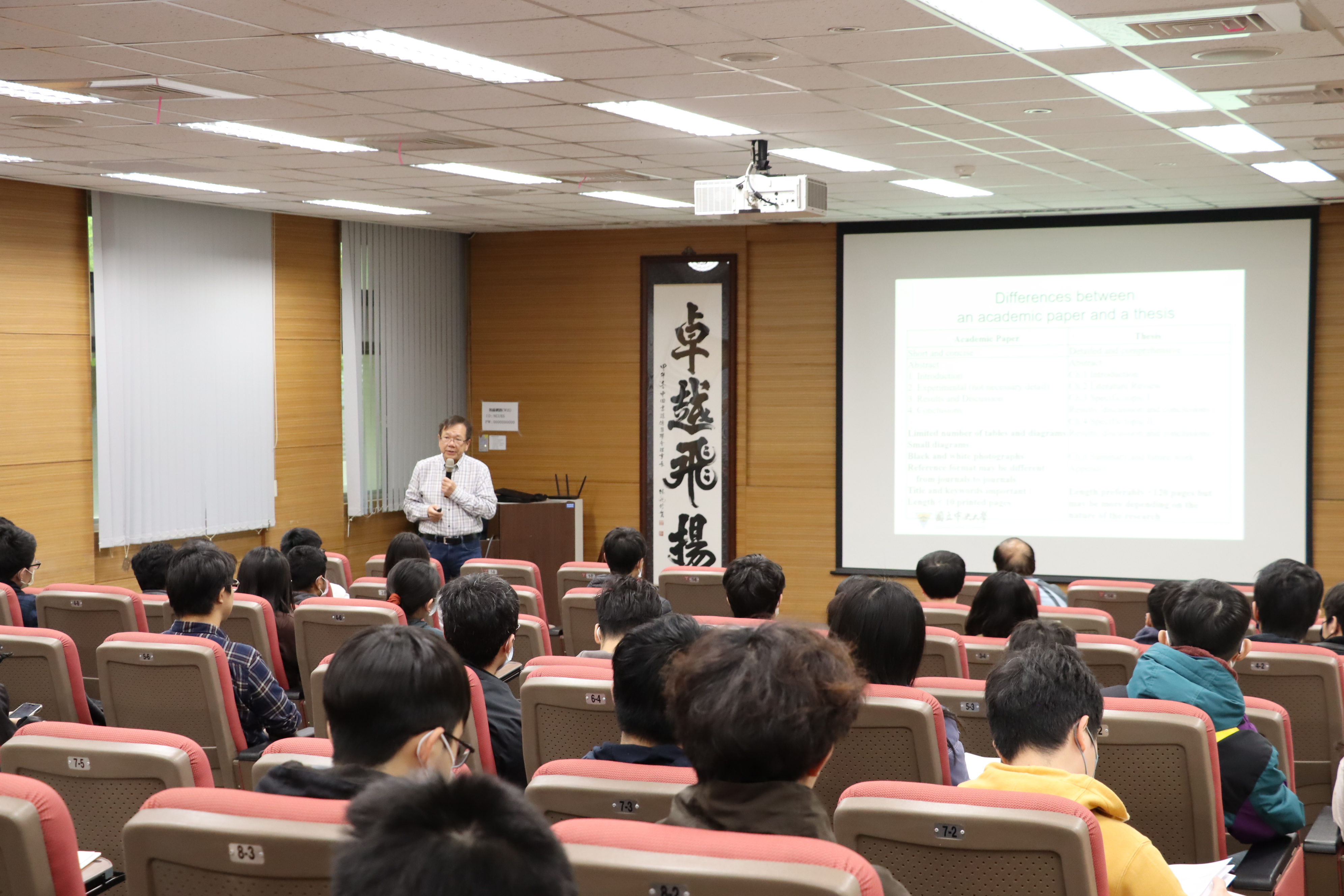
a. On March 28, 2023, we invited Prof. Sammy Lap Ip Chan from the Department of Chemical and Materials Engineering to deliver a lecture on 'Scholarly Publishing in International Journals'. He discussed the differences between academic and general articles, publishing purposes and trends, manuscript organization, as well as the role of editors in academic publishing. Additionally, the lecture offered insights on increasing citation rates and shared valuable tips for publishing academic articles in English.
b.On April 18, 2023, Professor Chan presented a lecture titled 'How to Survive Your Oral Defense', focusing on the preparation for oral examinations and the potential questions that could arise. Through simulated scenarios, he trained students in on-the-spot response skills and detailed the key considerations for oral exams, thereby equipping students with essential techniques and guidance for their successful completion.
F. Student-led Bilingual Communities: 'Talkie Talkies', a student-initiated community at the College, utilizes American TV series as training materials to boost members' confidence in English through listening and speaking exercises. They organize activities twice a week, which include listening to short clips and discussing practical topics, thus making the learning of English an enjoyable and educational experience. Another community, 'NCUMSE-ENM', focuses on enhancing listening skills in an entirely English-speaking environment. They use TED videos with English subtitles, supplemented by learning sheets and Duolingo game activities, to bolster members' concentration and participation while building their confidence in English. Through these bilingual communities, members are motivated to adopt an international perspective and connect with the global community.
To enhance the overall competitiveness of the College, our future plans include implementing cross-college and cross-disciplinary deep learning initiatives. These initiatives aim to offer students a diverse bilingual learning experience, broaden their international horizons, and in turn, strengthen the College's global presence.