National Taiwan University of Science and Technology-College of Electrical Engineering & Computer Science
To align with the development of the "2030 Bilingual National Policy Development Blueprint," the College of Electrical Engineering and Computer Science (EECS), with the support of the Ministry of Education, has progressively implemented bilingual teaching with remarkable achievements. In the initial stage of the project, the focus was on overall planning. The "EMI Promotion Committee" within the college served as the core execution unit, coordinating the allocation of resources and quality control for EMI courses across various departments. The committee successfully formulated the "College of EECS English-Medium Instruction (EMI) Teaching Award Regulations" and the "College of EECS Incentive Regulations for Taking EMI Courses." The goal was to simultaneously enhance English proficiency and expertise. The plan adopted a phased approach to course offerings, gradually immersing both faculty and students in an English-speaking learning environment. Throughout the execution period, the committee held seven meetings. Additionally, an "EMI Advisory Committee" was established to conduct annual evaluations and continuous optimization of EMI implementation strategies through expert supervision.
In the first phase of the plan, the college completed the construction of its exclusive EMI website, where all related information is disclosed for easy access by faculty and students. The plan covered three main aspects: students, faculty, and international collaboration, with significant progress and achievements in each area. The specific implementations are outlined as follows:
Students:
Course Development:
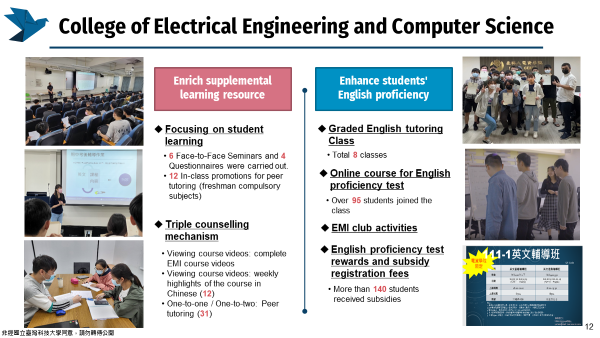
- Introduction of EMI concepts before enrollment, encouraging new students to participate in the "EMI Summer Academic English Prep Course" to prepare for EMI through activities like academic listening, reading, Academic Word List (AWL), and study skills.
- Progressive enrollment in EMI courses, with foundational courses in the first year and specialized courses in the second year. Over 220 EMI courses were offered during the plan period, with more than 7,000 student enrollments.
Counseling:
- Regular face-to-face communication with students through advocacy and seminars, conducting over 20 events during the plan period to understand students' learning situations.
- Implementation of a three-tier counseling mechanism, including video reviews, focused reviews, and tutoring sessions by teaching assistants (TAs), supporting 31 students.
English Proficiency Enhancement Measures:
- English proficiency programs, including physical English leveling tutorials, online tutorials, and the establishment of an EMI club with thematic content for oral practice. Two sessions of the club were held with 40 participants.
Course Rewards and English Proficiency Test Incentives:
- Establishment of regulations to reward students taking EMI courses, with over 4,000 students receiving rewards. Additional incentives for passing different levels of English proficiency tests, resulting in 52 students receiving awards.
Faculty:
Dual Incentive Mechanism:
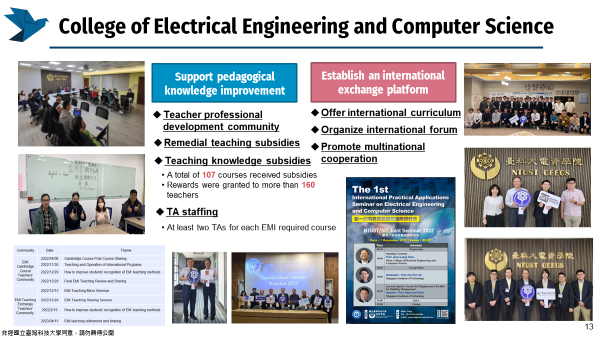
- Development of the "College of EECS English-Medium Instruction (EMI) Teaching Award Regulations," providing both university-level awards and college subsidies for teaching materials. The incentive system led to a significant increase in the number of EMI courses, with over 220 courses offered during the plan period.
Encouraging Pedagogical Competence Improvement:
- Promotion of EMI teaching competence improvement among faculty, with over 50% of faculty completing either Cambridge EMI online training or AIT EMI online courses, supported by the college with registration fees and teaching material expenses.
EMI Teaching Community Sharing:
- Encouragement of faculty to form communities for mutual exchange and support in EMI teaching strategies. Two communities have been established, organizing eight sharing and exchange events.
EMI Teaching Assistants (TAs):
- Assignment of 1-3 TAs for undergraduate professional compulsory courses to assist teachers in teaching and academic guidance activities, aiming to alleviate their teaching burden.
International Collaboration:
Offering International Courses in Collaboration:
- Collaboration with international faculty to conduct English-medium courses. Partnerships with Singapore Polytechnic for "Advanced Topics in Electrical and Computer Engineering" and with the University of Tokyo for "Introduction to Electrical and Computer Industries" were well-received by students, with nearly 130 students enrolled.
Establishment of an International Exchange Platform:
- Organization of physical exchange activities, such as the "College of EECS Practical Application International Forum" and a workshop in collaboration with Kyushu Institute of Technology. These activities enhance students' international exposure.
Organization of International Alumni Homecoming Events:
- Facilitation of direct communication and sharing of international experiences between international alumni and current students.
In summary, the initial stage of the college's bilingual program faced challenges that were gradually overcome with the support of the school and the cooperation of faculty. After two years of implementation, students' learning experiences have significantly improved. The college plans to continue its strategies, allocating more resources to support EMI teaching and assisting faculty in enhancing their capabilities. Additionally, the college will provide English training courses and related resources and activities to help students improve their English proficiency, further advancing the goals of international talent cultivation.