National Taiwan University of Science and Technology-College of Engineering
Improving Teaching Quality: Participation in Cambridge EMI Skills Training and Establishing a Teacher Growth Communities
To enhance the quality of student learning, the Teaching Development Center provides Cambridge EMI Skills training for improving teachers' EMI teaching skills. This training is an online self-learning course for teachers, covering vocabulary organization for English expressions in various academic contexts. After completing the course, teachers can assess their abilities through post-training tests. As of now, out of 180 teachers in the Engineering College, 51 have obtained the Cambridge EMI Skills certificate. The training empowers teachers with EMI teaching skills, allowing them to incorporate what they have learned into their teaching practices, facilitating students in better absorbing and understanding academic knowledge.
Within the Engineering College, teachers have also formed professional growth communities to facilitate the exchange of various EMI teaching methods and insights into course management. Through community collaboration and workshops, teachers can learn different teaching approaches. Currently, two teacher communities have been established, with 10% of teachers participating in the college's EMI practical community.
Ensuring Student Absorb Course Knowledge: Providing Support Resources
Teachers timely provide Chinese review materials for students to reinforce their understanding of course content after class. This helps students who may find it challenging to comprehend specialized knowledge in English during class due to language proficiency differences.
The role of teaching assistants is crucial in the instructional process. Therefore, the Engineering College encourages course instructors to appoint teaching assistants with strong English proficiency to assist in class activities and provide guidance in group projects. This assistance helps clarify student questions promptly.
Alleviate the suffering of studying EMI: Improve students' English ability
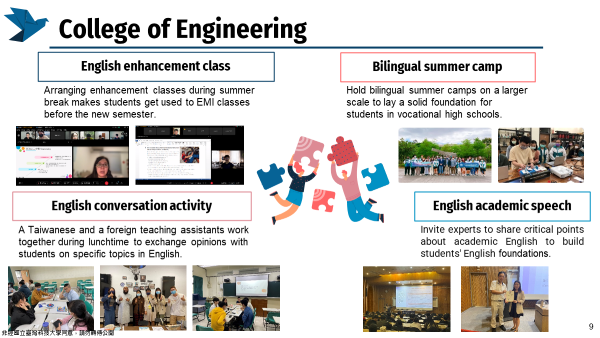
To address the teaching needs of engineering courses, the Engineering College offers a free online course called "Engineering English Enhancement" for all students within the college. The content includes commonly used English terms in mathematics, physics, chemistry, as well as guidance on writing assignments and papers in English. The course is applicable to students from the freshman year to graduate school. In the first trial in the summer of the academic year 110, 68 students enrolled, and 95.2% of the participants found the course helpful in adapting to an all-English teaching environment. Due to the positive response, the course will be offered again in the summer of the academic year 111, with 80 students enrolled, and a post-course English proficiency test will be administered for students to self-assess their learning effectiveness.
Addressing the need for English speaking practice, the Engineering College has initiated an "English Corner" since October of the academic year 111. Foreign and local teaching assistants jointly plan English conversation activities to help students improve their spoken English. So far, 24 sessions have been conducted.
Additionally, this semester, 180 online English courses are provided for college students, covering listening, reading, vocabulary, and speaking to enhance students' English abilities and prepare them for future EMI courses.
Enhancing Academic English Competence: Conducting Lectures on Academic English Strategies and Applications
In the academic year 111-1, a seminar on "Academic English Strategies and Applications" was conducted, with topics focusing on academic English and thesis writing. A total of 70 students participated.
Promoting International Exchange: Arrange international academic exchange activities
The Engineering College frequently collaborates with foreign universities to organize academic exchange activities. During these events, besides academic discussions, communication with foreign students is conducted in English. This not only promotes cultural exchange but also emphasizes the importance of English proficiency in engineering practice.
Example 1: The Mechanical Engineering Department collaborates annually with the Mechanical Engineering Department of Kyushu Institute of Technology in Japan to conduct a joint academic exchange program. The program involves task-oriented small group exchanges with each group comprising both Taiwanese and Japanese members. The focus is on predicting the future of the semiconductor industry's business models in both countries. Students engage in data collection and analysis, and mentors from both sides provide academic guidance.
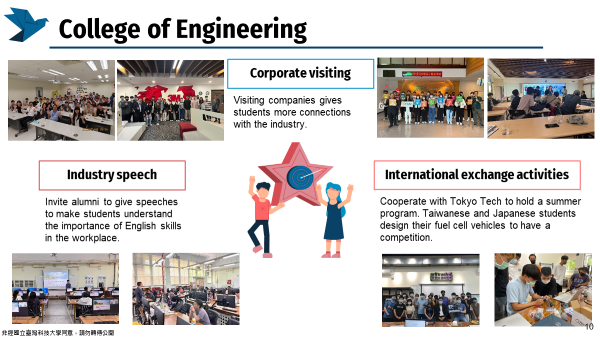
Example 2: The College's Global Development Bachelor's Degree Program collaborates with Tokyo Institute of Technology to organize a summer camp every year. In previous years, the camp was held through physical visits, but due to the pandemic, it was conducted online last year. Professors from Tokyo Tech and Taipei Tech from various fields such as materials, mechanical, and electronics conducted online lectures and facilitated post-course discussions in English between Taiwanese and Japanese students. The course involved designing hydrogen fuel cell vehicles using 3D printing technology. Taiwanese and Japanese students collaborated in groups for a competition, conducting the entire process in English as the language of communication.
EMI Teaching Takes Root: Extending EMI Courses to Senior High Schools
During winter and summer breaks and the regular semester, the Engineering College organizes technical high school enrichment camps, leading students in energy education experiences and practical courses. Some elements of EMI are incorporated into the curriculum by replacing one to two hours of originally Chinese-taught classes with EMI courses taught by foreign professors. This helps students get accustomed to the all-English teaching format and better prepares them for an all-English learning environment in their future studies.
Enhancing students' connectivity to the workplace: Promoting industry-aligned courses
The Engineering College has been actively collaborating with the industry, especially in recent years with the booming global smart manufacturing and semiconductor industries, leading to increased job opportunities in the engineering field. To enhance students' competitiveness in entering key national and emerging industries, the college introduced the "Advanced Semiconductor Process Equipment Program" last year. The EMI courses in this program invite scholars from renowned overseas universities such as Tokyo Institute of Technology and Waseda University to share advanced semiconductor equipment expertise and practical training with students. This program aims to bridge the gap between students' academic knowledge and industry needs, cultivating high-level talents for Taiwan's semiconductor research and development.
Furthermore, the Engineering College establishes channels for student-industry exchange by offering industry-sharing micro-courses. Lecturers from industry professionals, including instructors from UBEK Tech, Japan Airlines, SHARP, and Pilot Pen, are invited to share their experiences with students. The sharing focuses on the advantages and impact of foreign language proficiency in the workplace. This semester, students have been scheduled to visit well-known companies such as 3M and World Advanced Integrated Circuit Co., Ltd., for on-site visits. Through these visits, students gain insights into the industry's dynamics, explore future career directions, and cultivate the skills and knowledge required for employment during their academic studies.