National Yunlin University of Science & Technology-College of Management
Establishment of YunTech EMI Office as a school-level dedicated unit, with members including the Vice President, Director of Teaching Excellence Center, Director of Language Center, Dean of the College of Management, dedicated faculty from the College of Management, and assistants from various centers. The Teaching Excellence Center is responsible for EMI teacher training, the Language Center for enhancing students' English proficiency, and the College of Management for EMI courses and student counseling. The office holds regular group meetings to devise strategies, integrate and allocate school-level resources, track fund usage, and establish related policies (rewarding teachers and students for participating in English proficiency tests, rewarding students for taking EMI courses, and implementing English language course exemptions), ensuring the continuous progress of the EMI program, supervising project items, and ensuring execution schedules are met.
Additionally, there is an EMI community currently providing comprehensive EMI training for both teachers and teaching assistants (TAs). This includes developing training courses and growth mechanisms to enable teachers to articulate professional knowledge, conduct interactions and assessments, and discuss academic research in English during their classes. Incentives have been provided, such as a flexible salary supplement scheme (an annual subsidy of NT$120,000 for the teacher community), rewards for teachers who achieve C1 or higher in English proficiency tests (a subsidy of NT$20,000), guidelines for teaching English courses (additional TA funding and 1.5 times the hourly rate for teacher stipends), and opportunities for teacher promotion. These measures aim to help teachers become recognized instructors for EMI courses.
On the student front, efforts have been made to continuously enhance students' English proficiency through various means. These include:
- Free Academic English Courses (Intensive English Classes): YunTech offers free academic English courses to students, providing intensive language instruction.
- One-on-One Professors' Tutoring: Personalized tutoring sessions with professors are available for students to receive individualized support and guidance.
- Online English Learning Platform: An online platform is provided for students to engage in self-paced English learning.
- On-site TA Appointment-based Tutoring: TAs are available on-site for students to book appointments for tutoring sessions.
- Practice with Foreign TAs: Students can also engage in speaking practice sessions with foreign TAs.
In addition to these academic support measures, YunTech organizes regular English-related activities such as:
- International Culture Days (10 events): These events celebrate various cultures from around the world.
- National Festivals (2 events): Events to commemorate festivals from different countries.
- English Presentation Competitions (2 events): Competitions where students can showcase their English presentation skills.
Through these activities, both local and international students have the opportunity to understand and respect each other's cultures. During group discussions, students are encouraged to form groups with both local and international peers, which helps improve their oral communication skills in English. This immersion in an English learning environment is designed to be natural and effective.
Moreover, there are incentives in place to motivate students to meet the requirements set by the Ministry of Education. This year's Key Performance Indicators (KPIs) have already been achieved, indicating the success of these measures in encouraging and rewarding students for their English language achievements.
In terms of information disclosure, YunTech's College of Management offers 87 open EMI courses, which can be easily accessed through YunTech's centralized portal website. This portal provides potential students with detailed information about the courses, including course descriptions, learning objectives, teaching plans and schedules, assessment methods, and more.
For example, each department within the college has both Chinese and English websites that provide comprehensive course information, including enrollment handbooks and course flowcharts. At the beginning of each semester, teachers are asked to create a course glossary to assist students in EMI courses in various ways:
- Pre-Class Assistance: Before the course starts, teachers provide commonly used vocabulary (including pronunciation) and interactive sentence patterns to help students quickly understand the course topics.
- In-Class Materials: During class, teachers provide lecture notes, PowerPoint presentations, videos, and other supplementary materials to ensure students can keep up with the course content. Group discussions are also encouraged in class to foster student interaction and learning.
- Post-Class Support: After class, Teaching Assistants (TAs) and on-site TAs are available to assist students with class reports, assignments, or course content. This helps students review and test their understanding of the course.
All these resources and support mechanisms are in place to help students quickly grasp the content of EMI courses. The aim is to provide a well-rounded learning experience and ensure that students have the necessary tools to succeed in their studies.
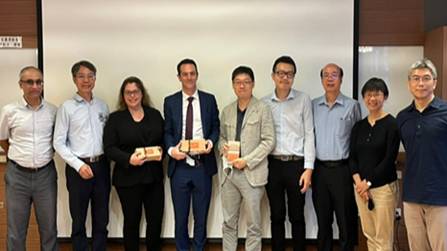
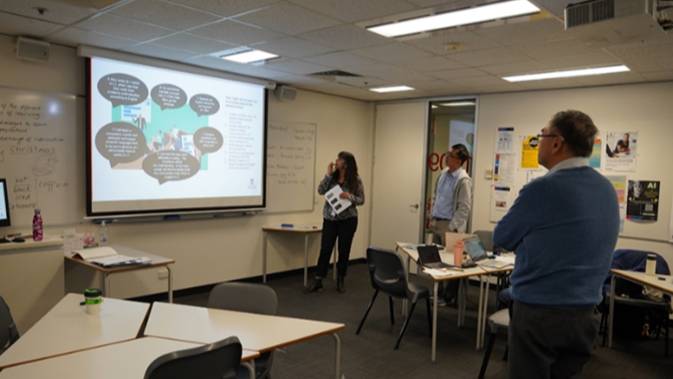
YunTech organized a bilingual learning international seminar to facilitate two-way exchanges between domestic and foreign scholars, aiming to enhance teacher capabilities and the quality of EMI courses. The total number of participants was 62 (20 from within the university and 42 from outside). The seminar featured our own faculty member, Professor Wang Yu-rui, along with Steven Murray, an advisor from the British Council, and Ben Beaumont, a senior training lecturer from the Oxford EMI Center. They shared insights on "Standardization of EMI Training to Create Best Practices in EMI."
The seminar focused on providing EMI teachers in Taiwan with a certification qualification through the CERT PT program, aiming to improve EMI teacher training. This seminar was a platform for sharing best practices and knowledge, contributing to the development of EMI education in Taiwan.
Quality Assurance Aspect: We have introduced teaching observations, categorizing classroom activities into four modes: teacher lecture time, teacher-student interaction, student-student interaction, and other activities. We observed 10% of the courses, selecting 5 courses for observation. We found that more than 80% of the class modes were conducted entirely in English. This allowed us to observe how teachers use English for classroom interaction, guide student thinking and expression of ideas, and provide effective class guidance.
Resource Sharing and Inter-Institutional Collaboration Aspect:
- We organized 2 cross-school EMI teaching sharing events, inviting teachers from similar departments across schools to participate. Teachers with expertise in EMI and extensive practical experience shared their insights and reports, fostering the exchange of bilingual teaching resources to enhance international perspectives and teaching quality.
- We established 6 cross-school (program) sharing communities, allowing teachers from similar fields across schools to learn from and share EMI course experiences. We invited experienced teachers to join and share professional knowledge, experiences, and best practices through online platforms, such as sharing information, teaching materials, and successful approaches.
- We conducted 8 EMI teacher or TA collaboration sessions, focusing on different courses. These sessions accumulated teaching experiences and guidance practices, allowing teachers and TAs to learn from and share EMI course experiences. This significantly enhances opportunities for diverse interactions between teachers and students.