:::
 Back to Year 2022
SCHOOL
National United University
Abstract
Summary of Program Self-Evaluation Report
The University participates in the Bilingual Education for Students in College (BEST) Program of the Ministry of Education as a universal enhancement university. A summary of program implementation and highlights for the 2022-2023 academic year is provided below:
(1) Measures to Enhance Students' English Proficiency
- To adjust the teaching content according to students' English proficiency: During the first three weeks of each semester, freshmen are tested on their English proficiency using the English Proficiency Diagnostic Platform developed by the Center. The results of the test allow each teacher to compile data on the strengths and weaknesses of the students in the class (in 30 different areas), and then adjust the content and direction of the teaching.
- To provide diversified and adaptive English courses: According to students' individual learning preferences, a "multiliteracy-oriented" English learning approach is adopted to achieve the goal of knowledge construction through a process of mutual interactions. With the principle of multi-dimensional learning, the curriculum is designed by applying practical and life-oriented concepts of multi-adaptability. Through accompaniment, observation, diversified assessments, and customized curricular activities, the curriculum stimulates the students' strengths and talents as well as enable them to be taught according to their aptitude, in addition to enhancing their performance in multiple intelligences. In the classroom, students are introduced to different cultures and current affairs, which incorporated a diverse set of learning modules, including literature, business, communication, globalization, digitalization, and other areas of English learning. The Center offers a variety of courses for freshmen to choose from, such as English Presentation, Abstract Writing, English Dubbing, and English for Backpackers.
- To establish an immersive language learning environment with multiculturalism and international cooperation: The Language Center invites a number of foreign teachers to teach at the University. These foreign teachers bring the perspective of different cultures to the University, and offer international cooperation courses that allow students to interact with students from other countries, creating a fully English speaking environment.
(2) Support Measures for Curriculum and Instruction
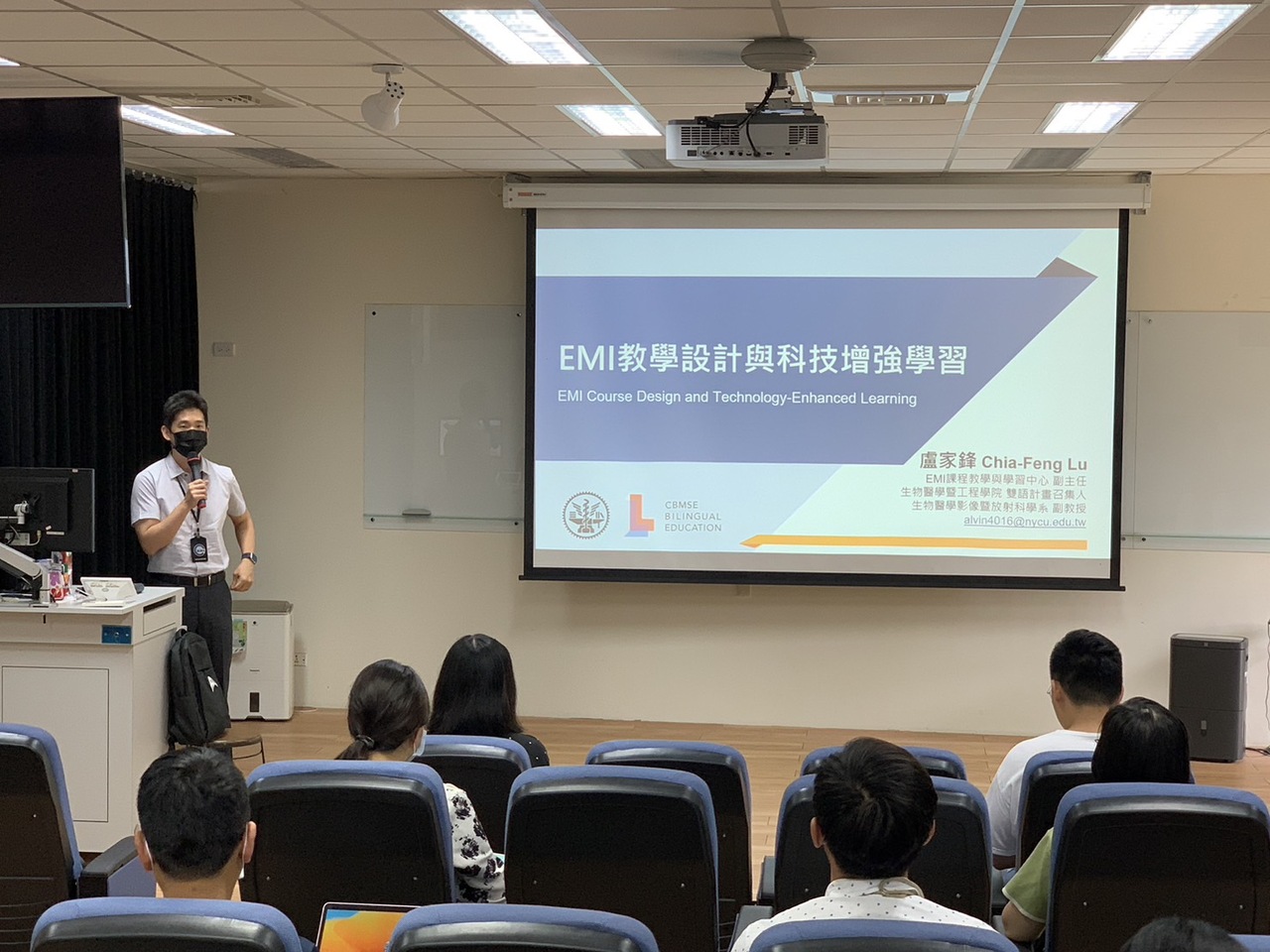
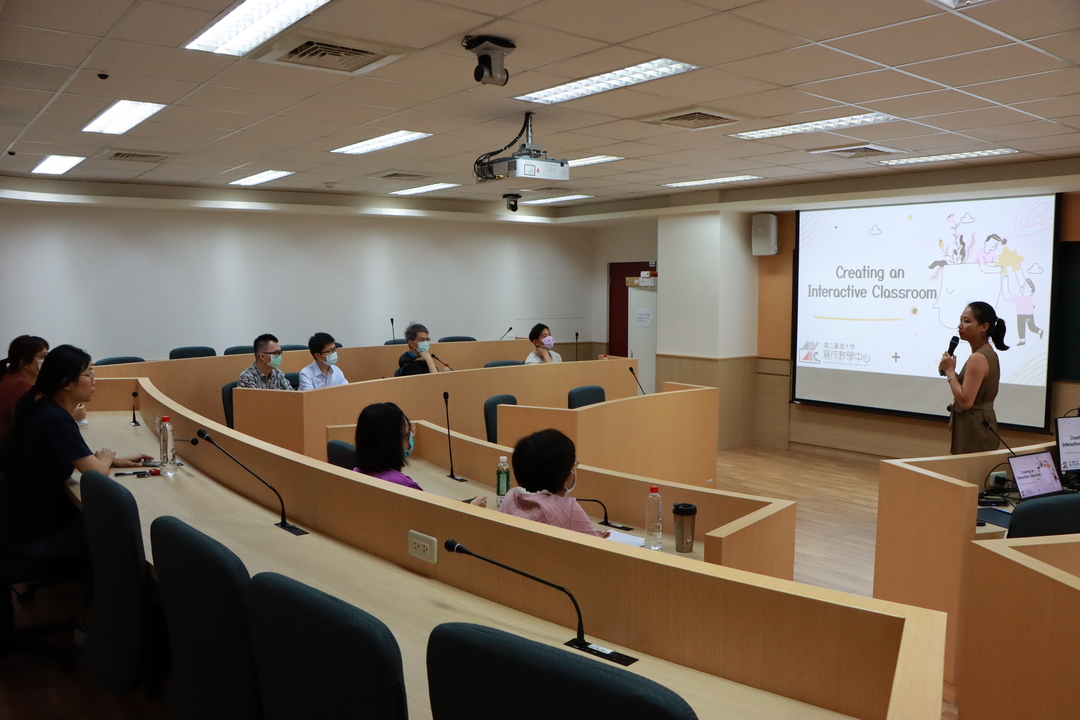
- To coordinate internal and external resources to enhance teachers' knowledge of teaching in English: The "Directives for the Promotion of the Use of English as the Medium of Instruction in Professional Courses at National United University" was set up in the 2022-2023 academic year to improve the support measures for the EMI program. In order to enhance teachers' English teaching skills, two EMI teacher training workshops were held on campus, 16 teachers were subsidized to take the online EMI teacher training course offered by Oxford EMI Training, and Grammarly accounts provided by the EMI Teaching and Learning Center of National Taiwan University were offered to 65 teachers at the University for application.
- To establish an on-site support mechanism for teaching: 29 teaching assistants were trained to assist in professional courses taught entirely in English as well as English classes, and industry professionals were brought in to teach 3 courses in English. In addition, grants were provided to the teachers of 11 EMI courses, 2 professional courses taught entirely in English for part of contact hours, and the R&D of teaching materials for 1 ESP course.
- To create incentives for students to take EMI courses, thereby stimulating the students’ motivation to study: In the 2021-2022 academic year, the "Regulations Governing the Issuance of Certificates of Completion and Passes in Courses with English as the Medium of Instruction" was established, and "Certificates of Completion and Passes in Courses with English as the Medium of Instruction" have been issued to graduates of master's degree programs and bachelor's degree programs since the second semester of the 2021-2022 academic year. In the 2022-2023 academic year, the Directives for the "Participation in Off-campus Open Online Professional English Courses" and "Enrollment in On-campus Courses with English as the Medium of Instruction" were revised to provide a total of 15 students with awards for the purpose of strengthening students' motivation to take EMI courses.
(3) Development of the University's International Affairs
- To promote international education through the dual degree system. The University is planning to set up an international admissions database, such as a website for international admissions in English and a video for admissions in English, to provide complete information for international students to enroll in the University. In terms of 3+2 dual degree program enrollment, the University has admitted 3 international students in 2022 and 5 in 2023. 8 foreign students are expected to graduate from the University's Department of Business Administration, Department of Mechanical Engineering, and Department of Civil Engineering in the coming two years; The University published a newsletter in the academic year of 2022-2023, which was sent to sister schools to provide information about the University's efforts in internationalization.
- To enhance international enrollment and teacher-student exchanges: The University enrolled 32 international students in the 2022-2023 academic year; 15 foreign students in the 2023-2024 academic year, plus 5 students coming to the University to study in the 3+2 Dual Degree Programs, the number of foreign students is actively increasing; in addition, 2 students went to the University of Nebraska in the U.S. and the Otto-von-Guericke University Magdeburg in Germany for a semester exchange, and there are 6 students (4 students are members of the World Youth Volunteer Association) went to Japan for a short-term exchange and 20 students went to Germany, Belgium and Singapore for an overseas internship. In the second semester of 2022-2023 academic year, more than 40 international faculty members and students from the United States, Australia, Korea, Japan, Russia, Canada, Indonesia and Vietnam have visited the University, and it is expected that more than 100 faculty members and students from sister universities will visit the University in the 2023-2024 academic year.
- To strengthen international research partnerships: The University has added six international sister universities, including University of Economics Ho Chi Minh City in Vietnam, Satya Wacana Christian University in Indonesia, and Sahmyook University in South Korea, and invited them to visit the University to discuss the possibility of reinforcing academic collaborations and partnerships. In addition, an online Taiwan-Japan Symposium with sister schools was held, featuring a total of 79 academic papers, including 50 oral presentations and 29 poster presentations, with a total of 198 participants, to train students' competencies in English for academic purposes.
The University also accomplishes self-evaluation in the following ways:
- Setting KPIs to assess the effectiveness of the plan: The University sets quantitative KPIs based on the four major strategies of promoting the goals of teachers, students, curriculum and international school affairs. Regular meetings are held at the school level and in working groups to control the progress of the KPIs and to select relevant topics for analysis in conjunction with the study of the University's affairs, so as to review the effectiveness of the KPIs and ensure that the direction of the plan is consistent with the strategies of the plan. The implementation of KPIs for the 2022-2023 academic year is shown in Table 1.
- Results review and feedback mechanism: In the 2022-2023 academic year, a total of two promotion sessions for EMI courses were held before the semester course selection for students to understand the learning status of students and their suggestions for EMI courses and subsidies; a questionnaire survey for teachers was implemented to promote the teaching of EMI courses, to understand the problems faced by teachers in the first line of EMI courses and their needs for assistance, and to plan relevant measures in the direction of implementation in order to achieve the goals of the plan. This will be used as a direction for planning relevant measures for the review purpose.