National Taipei University of Nursing and Health S
National Taipei University of Nursing and Health Sciences aims to "become an exemplary university for nursing and health sciences in the Asia-Pacific region," reflecting its educational aspirations. Throughout the years, the university has excelled in nurturing talent within the nursing and healthcare fields. It leads the nation in the pass rates for the nursing licensure exam and boasts impressive employment rates, with its esteemed alumni occupying key managerial roles in medical institutions across Taiwan. Aligned with Western standards, the university's professional training and quality of curriculum planning have established its reputation as a model university in Taiwan and facilitated international cooperation with allied countries in healthcare professional training.
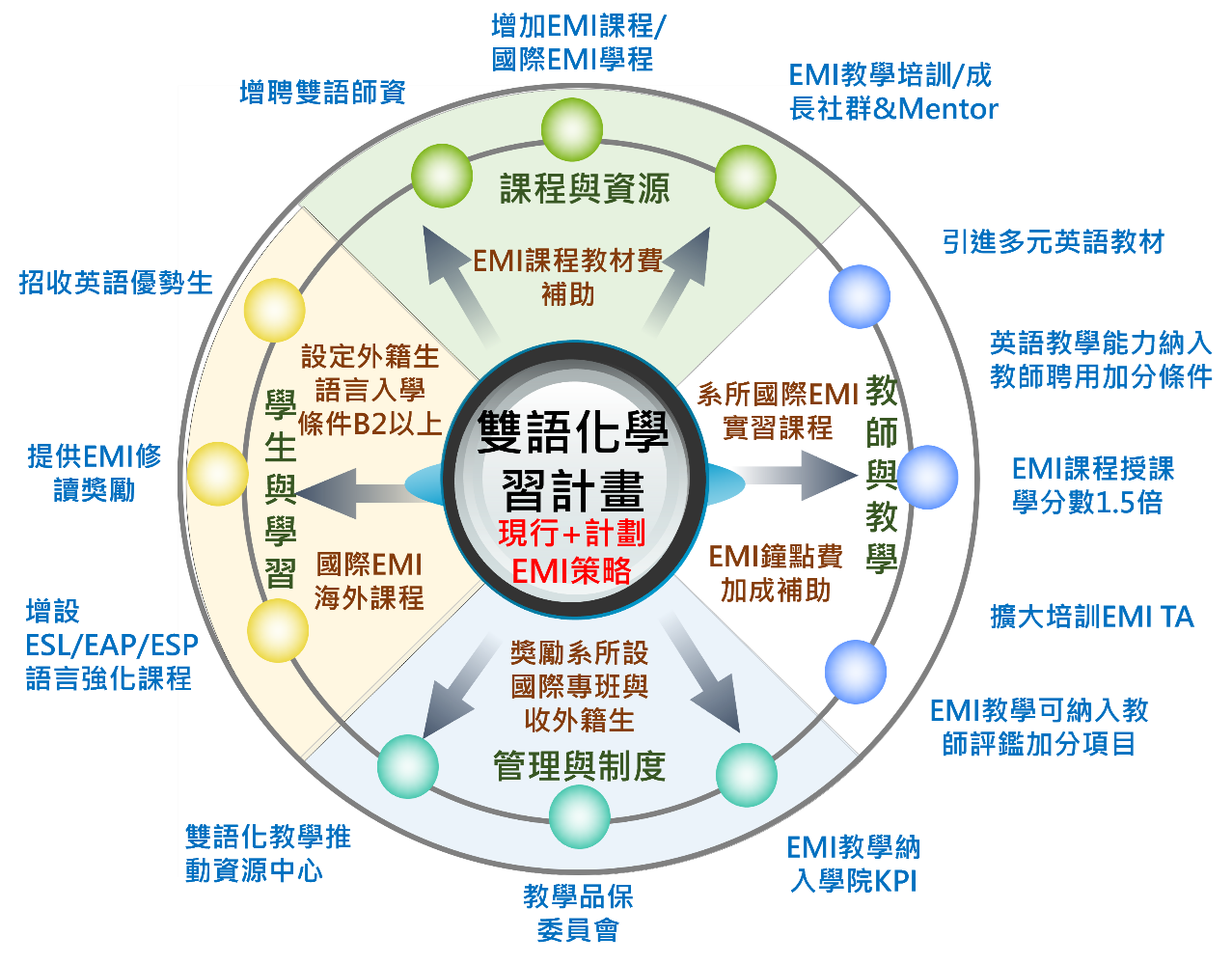
The university implemented the BEST project in line with the university’s 2022-2026 mid to long-term strategic plan. Regular curriculum quality assurance meetings are conducted to ensure that students benefit from high-quality EMI courses (English as a Medium of Instruction). In order to provide the faculty with ample preparation opportunities, our BEST project focuses on five key areas: "Institutional Strategy and Management," "Teachers and Courses," "Students and Learning," "Quality Assurance," and "EMI Collaboration." The self-assessment summary for the 2022 academic year presents the following achievements in relation to set indicators:
1. Institutional Strategy and Management
- Departments offering EMI courses: 10 departments, one interdisciplinary college, and one center, representing 85.7% of the university, exceeded the goal of 9 departments/75%.
- Students with advantage in English proficiency: 153 students/5%, surpassing the goal of 135 students/4%.
- Addition of Bilingual faculty: 6 faculty members, surpassing the target of 4.
- EMI courses in partnership with foreign institutions: Achieved. 9 courses
- Establish a dedicated unit for bilingual education: Achieved. A university-level bilingual teaching resource center is established.
2. Teachers and Courses
- EMI teachers: 52 teachers, constituting 25%, exceeding the target of 50/24%.
- EMI faculty training sessions: 57 sessions, above the goal of 55.
- ESL/ESP courses: Achieved. Offered for 3 batches of students, engaging up to 600 students.
- EMI courses: 69 courses, or 4.8%, surpassing the target of 60/4.2%.
- EMI/ESL teaching materials introduced annually: Achieved. 4 EMI/ESL teaching materials were introduced.
3. Students and Learning
- English courses taught entirely in English (Indicator assigned by the Ministry of Education): 23.4%, above the target of 20%.
- Improvement in students’ English proficiency: Sophomores at 4.0%, seniors at 4.1%, exceeding the goals for sophomores (3.2%) and seniors (3.2%).
- Sophomores and first-year master’s students taking at least one EMI course (Indicator assigned by the Ministry of Education): 6% and 6.1%, respectively, surpassing the targets of 5% and 5.1% each.
- ESL course enrollment rate among students of the four-year technical programs: 55 students or 4.2%, exceeding the target of 4%.
- Recruitment of foreign students with CEFR B2 level English proficiency or higher: Achieved. 100%.
4. Quality Assurance
- EMI quality assurance meetings: Achieved. 2 meetings were held.
- Teacher participation in EMI training: 25 teachers or 12%, exceeding the goal of 20/10%.
- EMI professional development activities for teachers: Achieved. 2 activities were held.
- Collaborations with foreign universities on EMI: 14 cases, surpassing the goal of 12.
5. EMI Collaboration
- EMI teaching sharing sessions: 2 sessions, above the target of 1.
- International university accreditations and subject rankings: Achieved QS five stars and ranked 62nd globally in the QS World University Rankings for Nursing, far exceeding the target of QS five stars/ARWU top 100.
To assess the EMI course offerings and meet self-assessment objectives, the university holds annual quality assurance meetings, inviting internal and external experts, interested faculty members, and students to share their feedback. The project is overseen by the president of the university, who conducts 12 management meetings annually to monitor and guide monthly progress These meetings, attended also by department heads and deans from various administrative offices, facilitate cross-project collaboration and provide an opportunity for committee members to offer suggestions on fine-tuning project specifics. For more information on our university's bilingual project, please visit:
https://iroffice.ntunhs.edu.tw/p/412-1013-2457.php?Lang=zh-tw