CHUNG SHAN MEDICAL UNIVERSITY
Program Features
Chung Shan Medical University is a medical institution that acknowledges the rapid advancement of knowledge in the medical field and the essential role of English in medical communication. Therefore, we emphasize the development of international communication and professional skills among our students and faculty as key components of our overall institutional growth. To achieve this goal, we actively and openly supported the implementation of bilingual education and encouraged all members of the community to participate. This was to ensure that students acquired international communication and professional skills and to establish an internationalized campus. Seventy percent of the departments at our school require students to obtain professional licenses before graduating. Additionally, English was not the primary language of instruction. To successfully transform the curriculum, we adopted a gradual approach and began by introducing elective courses. In the first year of the 110th academic year, the first semester focused on teacher training, while the second semester emphasized the promotion of all-English instruction through elective courses. From the second year onward, we began implementing support measures aimed at enhancing student learning and teacher instruction from various perspectives. We also introduced supplementary external resources to boost teachers' motivation and students' enthusiasm for learning. This effectively improved students' English proficiency and created a bilingual environment.
Key Achievements
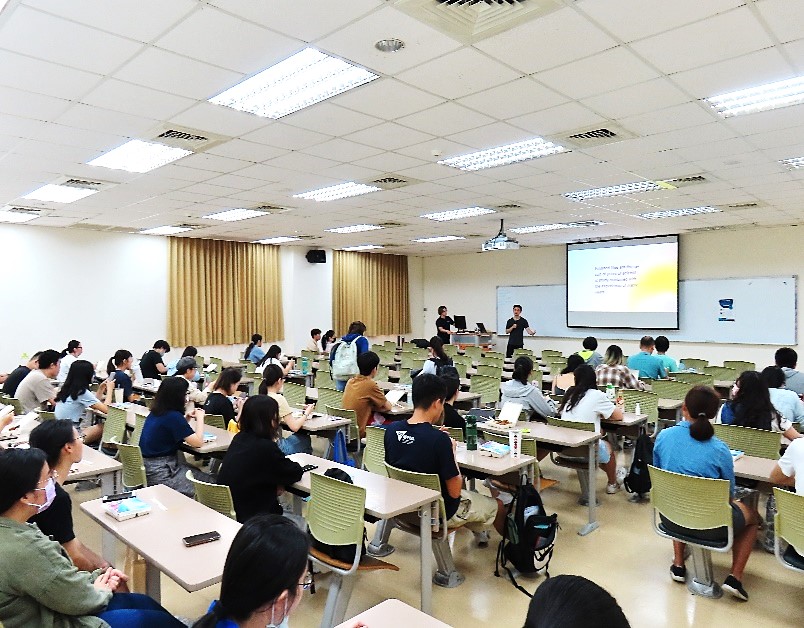
Organization: Our university aims to promote English language instruction, enhance teachers' English teaching skills, support student learning, and create an enriched English learning environment. The EMI Center fully promotes bilingual teaching and instruction in English. Under the guidance of the Committee for the Promotion and Consultation of English-Medium Instruction (EMI) Courses, the Center has completed the development of relevant regulations, including administrative guidelines, training plans, and reward systems. It also performed tasks such as teacher training, student activities, curriculum review, and inter-school cooperation. At the same time, the school had introduced a language requirement for international students. In addition to demonstrating basic English proficiency, foreign students were also required to provide a Test of Chinese as a Foreign Language (TOCFL) certificate.
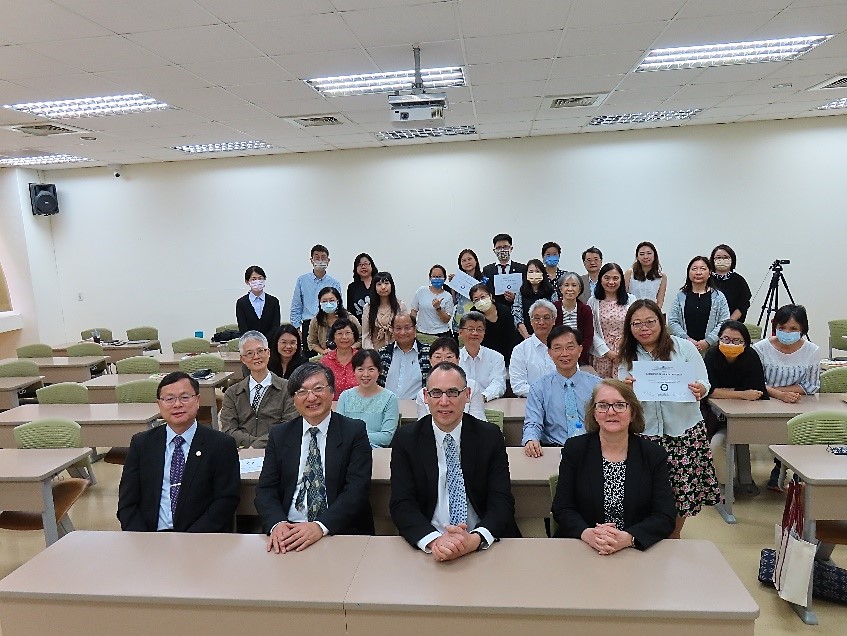
Teachers: EMI teacher training was conducted to motivate educators to complete the Cambridge EMI training and the teacher training program in collaboration with Andrews University, our partner institution in the United States. Starting from the 111th academic year, we have collaborated with the Bilingual Resource Center of Wenzao Ursuline University of Languages to offer regular teacher training courses. By then, 51 teachers had obtained EMI teacher training certificates. The EMI Center has organized numerous activities, including seminars to share teachers' teaching achievements, workshops, and teacher empowerment seminars, to facilitate the exchange of teaching experiences among teachers and enhance the quality of English teaching. Teachers who offered courses taught entirely in English and recognized as EMI (English as a Medium of Instruction) courses were eligible to receive bonuses.
Students: Students who took EMI courses were rewarded. A total of 224 students received bonuses during the span of two academic years. After class, students with varying levels of English proficiency were provided with intensive English courses and resources, such as English proficiency tests, the EnglishScore app, and an English practice system. Students were encouraged to take English for General Purposes (EGP), English for Academic Purposes (EAP), or English for Specific Purposes (ESP) courses before enrolling in English as a Medium of Instruction (EMI) courses. English competitions were held, and subsidies were provided for English activities organized by clubs and departments.
Curriculum: By training and supporting teachers to deliver courses in English as a Medium of Instruction (EMI), the entry requirements for undergraduate EMI courses have been reduced. Students can search for courses taught entirely in English using the course selection system, and the EMI Center website regularly updates a list of available EMI courses. The proportion of English as a Medium of Instruction (EMI) courses in our school has reached 40% of all English courses.
Resource Sharing and Inter-school Cooperation: We collaborated with several universities and educational institutions, including Wenzao Ursuline University of Languages, Andrews University in the United States, and Fulbright Taiwan. We co-organized teacher training courses and seminars on English as a Medium of Instruction (EMI). Through teacher workshops and by inviting experts and scholars, we facilitated the exchange of resources and ideas to enhance the quality of teaching. EMI courses, co-taught by instructors from partner schools abroad, are available to facilitate cross-school exchange and collaboration.
Building an In-School English Teaching and Support System: The EMI Center has established an in-school English teaching and support system by promoting inter-school cooperation. The tasks included promoting bilingual teaching, enhancing students' English proficiency, improving teachers' instructional skills, and establishing a teacher-student community and exchange platform. Furthermore, we partnered with Andrews University in the United States to establish a 5-year integrated bachelor's and master's degree program, offering students expanded opportunities to enroll in international courses. We offered English teaching and learning materials that covered all aspects.
Other supporting measures included conducting EMI TA workshops and establishing a talent pool for teaching assistants (TAs). A bilingual teaching resource classroom has been established. LTTC has been commissioned to open a special English class for employees. Medical and nursing professional seminars were conducted to enhance students' professional English proficiency and career planning.
Mechanism of Evaluation and Management: The Committee for the Promotion and Consultation of English-Medium Instruction (EMI) Courses was responsible for coordinating the deliberation of bilingual education strategies, reviewing examinations and management, coordinating teaching promotion, establishing self-assessment criteria, collecting suggestions, and enhancing the implementation of the plan. The consultation included external experts and scholars. Through academic conferences, weekly meetings, and class representative gatherings, the EMI plan was promoted to encourage teachers and students to participate and offer suggestions.