Chihlee University of Technology
The university is in the process of establishing a high-quality bilingual environment in accordance with the implementation strategies outlined in The Program on Bilingual Education for Students in College. Following the enhancement of their English proficiency, students have further developed specialized professional and international capabilities, enabling the program to generate a synergistic effect of cultivating students into outstanding international business talents. To sustain the promotion of bilingual education, a Bilingual Education Resource Center has been established under the Division of Academic Affairs. This center is dedicated to promoting and managing resources required for bilingual education, with the Dean of Academic Affairs serving as the executive director. To effectively implement English as a medium of instruction (EMI) and ensure the quality of teaching, an Advisory Group of Experts on Bilingual Education comprising four off-campus international experts and scholars as consultants has been formed. Regular meetings are convened to focus on assessing the appropriateness and development of EMI courses, thereby enabling timely adjustments and improvements. Additionally, institutional research and analyses concerning bilingual education topics are conducted to examine the implementation outcomes of the bilingual program. The university has achieved remarkable results in implementing the first phase of the plan. The characteristics and highlights of the five major strategies are as follows:
A. Promotion of Professional EMI Courses
- Development of specialized EMI courses: In accordance with the educational objectives and core competencies of each college, 18 EMI courses in professional fields were established in the 2022 academic year, with 15 courses being for sophomores and 3 courses being for first-year graduate students. In total, 24.6% of sophomores and 95.2% of first-year graduate students enrolled in at least one EMI course to enhance their professional knowledge and broaden their global perspective
- Talent cultivation and talent war through interdisciplinary programs: To enrich the existing professional EMI courses and cultivate talents with international business expertise, efforts are underway to promote dual-degree programs that align with international standards. By running interdisciplinary credit programs and microcredential courses, the university is committed to developing interdisciplinary international courses to cultivate diverse professional abilities among students. To promote the dual-degree system, the Interdisciplinary College Credits Program in EMI International Business was launched in the 2022 academic year.
B. Increase EMI Teacher Training Capacity
- Enhance English speaking proficiency among teachers: To encourage teachers to establish professional EMI courses, the university collaborated with foreign language schools to organize a course to enhance the English speaking proficiency of the teachers, thereby improving their English communication skills. The course, conducted through one-on-one synchronous online teaching, focused on developing speaking, listening, grammar, and conversational skills. A total of 32 teachers participated in the course, with 88% of them reporting satisfaction with their learning outcomes.
- Advancement of EMI Teaching Skills: The universitycollaborated with Studio Classroom to organize the training event entitled “EMI Teaching Advancement Workshop.” The online course offered flexible learning opportunities without location and time constraints. Upon completion and passing relevant assessments, teachers received an EMI teaching certification. In the 2022 academic year, 13 teachers obtained an EMI teaching certification, becoming seed teachers for the university’s EMI programs. Overall satisfaction with the course was rated 4.34 out of 5. To enhance the ability of teaching assistants in EMI course support and in assisting teachers to provide EMI course support, the university offered training courses on creating teaching slides. In terms of their performance, the EMI teaching assistants received a satisfaction score of 4.67 from both the EMI teachers and students.
- EMI Teacher Incentive Mechanism: Guidelines for Selecting and Rewarding Outstanding EMI Teachers were formulated. Three outstanding EMI teachers were selected, each of whom received a monetary award of NT$20,000 and course observation opportunities, which involved them coaching other teachers in implementing EMI courses
C. Leveraging Technology to Popularize Individualized Learning
- Autonomous learning to enhance oral proficiency: Using novel technology developed on the basis of big data, the university facilitates instant assessment and certification of English language productive skills for its students. Students are encouraged to use digital assessment platforms for self-evaluation of language proficiency, fostering a habit of autonomous learning. In the 2022 academic year, 1,196 freshmen participated in the assessment of oral proficiency training, with the majority of them demonstrating a CEFR A2 level (33.6%) and B1 level (33.7%) of proficiency.
- Digital learning and knowledge overhaul: The university worked withStudio Classroom to develop courses targeting various professional categories in an attempt to enhance knowledge of professional English vocabulary and phrases among students. This initiative assists students in planning their future career development and expanding their global perspective. The courses are conducted online to eliminate spatial and temporal constraints, offering students unrestricted access to learning resources. In the 2022 academic year, 475 students enrolled in these courses, with a course completion rate of 85%.
D. Creating an Environment for International Resource Sharing
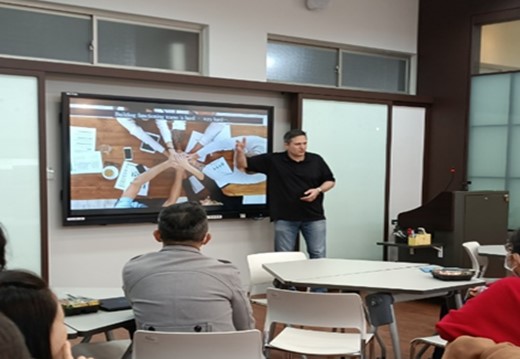
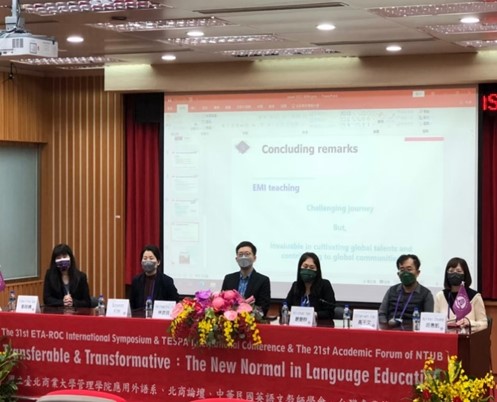
- Sustainable education through international forums: To enhance the quality of EMI, EMI faculty members actively acquire new teaching knowledge from both domestic and international sources. To this end, the university organized three EMI international teacher forums, inviting domestic and international bilingual education experts and scholars to share and exchange EMI techniques, development, and strategies. A total of 163 teachers on and off campus participated in these forums, sharing experiences and exchanging ideas. The satisfaction level with the learning outcomes of these events was rated at 4.77 out of 5.
- Multiplier effect from using the EMI website: The university established an EMI online platform to maximize the sharing of academic resources. In the 2022 academic year, this platform added teaching materials and instructional videos for 28 EMI courses, providing resources for related activities, recordings of actual cases, and presentations of students’ learning outcomes.
E. Strengthening Fundamental English Communication Skills Among Students
- Tailored English teaching materials: To meet the development needs of the core competencies of each college, the university established the content of English courses on the basis of professional knowledge and skills relevant to each college to ensure the suitability and appropriateness of the teaching content. The university is committed to creating high-quality EMI courses. The proportion of EMI courses increased from 10.2% in the 2021 academic year to 24.6% in the 2022 academic year.
- All-English industry experience for talent cultivation: To enhance workplace communication skills among students, a variety of workplace situational simulations and workplace experience activities were organized to cultivate professional English abilities among students, thereby enabling students to use English more fluently in both the workplace and in daily life. In the 2022 academic year, the university collaborated with the GIS Convention Center to organize an all-English workplace experience camp. The event attracted students from nine senior and vocational high schools in New Taipei City.