Wenzao Ursuline University of Languages-College of English and International Studies
Implementation of the Outcome of the 111th Academic Year
I. Preface
The Program on Bilingual Education for Students in College (BEST Program) aims to increase the proportion of professional EMI (English as a Medium of Instruction) courses within the College of International Culture, Education, and Foreign Affairs. This enables the cultivation of more international interdisciplinary talents. The College adopts a developmental strategy from "English proficiency specialization" to "professional competence internationalization" as its goal, implementing the seven performance indicators of the BEST Program.
II. Performance Indicators of the Bilingual Program (Seven Aspects)
(I) Institutional Strategy and Management
The College adopts the following four practices: (1) Before the start of the 111th academic year, the College organizes a professional competence growth workshop for all teachers, led by the College President, discussing "Does Wenzao need EMI?" to communicate the EMI policy with all teachers. (2) To help stakeholders understand the college's policy, the College establishes the EMI Course Committee, consisting of 6 directors of departments/centers, 6 teacher representatives, and 2 student representatives (including one international student), to promote matters related to all-English teaching. The College also discusses the implementation of EMI courses in college affairs, curriculum, and department/center meetings. (3) Regarding curriculum planning, the English Department and the English Teaching Center of the College offer ESP (English for Specific Purposes) courses that can be credited toward the standard English requirements. In the 111 academic year, 31 ESP courses were offered, and instructional levels were planned based on the College Student English Proficiency Test (CSEPT) results from Level 1 to ESP modules. (4) the campus has a comprehensive bilingual labeling system regarding campus internationalization. All international students are integrated into local student classes, with only Chinese language courses taught separately.
(II) Teachers and Teaching
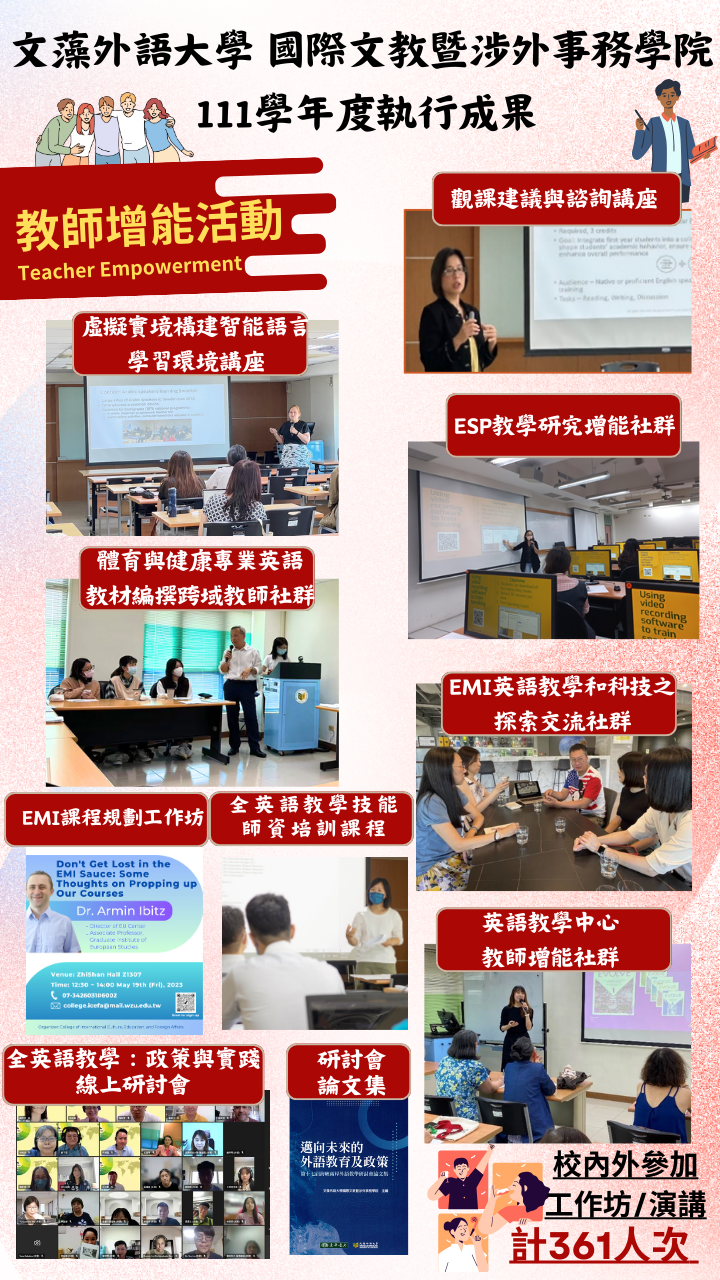
The College provides teacher support systems and incentive measures through the following three practices: (1) To enhance teachers' EMI skills, the College serves as the EMI teaching instructor for the Southern Region Resource Center, with a total of 16 instructors conducting 108 training courses (totaling 756 hours) as of May 8, 112, assisting 552 trainees. (2) In terms of incentives, the College rewards full-time teachers who offer online EMI courses. As of May 8, 112, the College has rewarded 16 teachers, with a total of NT$200,000. (3) Establishing the EMI teacher community: In the 111th academic year, a total of 9 EMI-related communities were established (including 3 inter-school communities), organizing a total of 10 physical and online bilingual teacher workshops and sharing sessions, with a total of 110 participants inside and outside the school. (4) Rewarding teachers with English proficiency at CEFR C1 and above, a total of 1 teacher was rewarded.
(III) Students and Learning
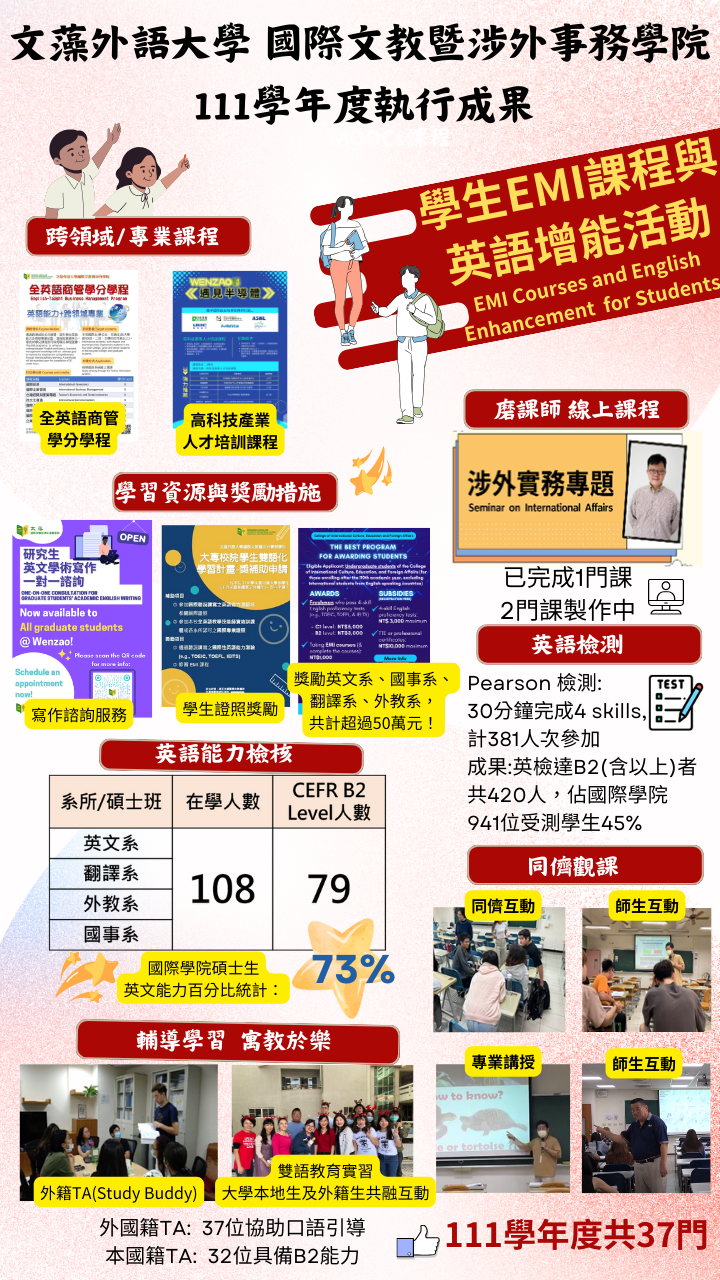
The College implements four practices to provide English support systems and incentive measures for students: (1) Tracking English proficiency: To assess the English abilities of students, all freshmen are required to take the University English Test before admission. Among the freshmen, 10.91% have achieved a CEFR B2 or above proficiency in listening, speaking, reading, and writing. The post-test, covering listening, speaking, reading, and writing skills assessments, was conducted on May 6-7, 112. (2) Language learning resources: To enhance students' English speaking abilities, the College arranges themed speaking practice sessions with 30 foreign teachers or English/foreign language tutors. (3) In terms of incentives, the College provides financial assistance to 562 students, totaling NT$583,000. (4) Regarding course effectiveness, the College has offered 160 physical EMI courses and 1 online course (including courses on MOOCs, an online learning platform) as of May 8, 112, with plans to offer 3 courses in the 111 academic year. In the first semester of the 111 academic year, 54% of the College's sophomores and 46.2% of the first-year graduate students took over 20% of their credits in all English courses. Additionally, 32.7% of them achieved CEFR B2 or above in listening, speaking, reading, and writing, meeting the Key Performance Indicator (KPI) set by the Ministry of Education.
(IV) Information Disclosure
The College adopts three practices for external and internal promotion: (1) The College has host an online full-day "All-English Instruction Policy and Practice Conference" in July 2023, sharing the results of the College's EMI teaching research with domestic and international universities. (2) The College has a bilingual program page on its website, presenting introductions, critical points of teacher and student incentives, all-English teaching schedules, activity results, and external resources related to the bilingual program. This information is also announced on the homepage. (3) Internally, the College printed posters and conducted an online briefing session in November 2022, with a total of 46 attendees from the faculty and students.
(V) Quality Assurance
The College implements five practices for quality assurance: (1) To ensure that all courses comply with the operational definition of the Ministry of Education's EMI courses, newly opened courses must go through the College-level EMI Course Committee and then be sent to the College Curriculum Meeting for approval before they can be offered. (2) All 57 EMI teachers in the College, including those who support this program, have personal and course files, including records of teachers' professional growth, EMI course outlines, and samples of student assignments. (3) Conducting classroom observations: In the 111th academic year, 37 teachers (accounting for 65% of all College EMI teachers) were carefully observed by teaching assistants to assess the ratio of using Chinese and English and the interactivity of their classes, providing feedback to EMI teaching teachers. (4) In the first semester of the 111th academic year, the College compared the teaching evaluations of 88 EMI courses and 270 non-EMI courses (average scores of 4.59 and 4.60, respectively), with no significant differences found, indicating that the language of instruction did not affect learning quality. (5) The College surveyed 659 students who took 95 EMI courses in the first semester of the 111th academic year, achieving the highest satisfaction across the College with a score of 4.46 (out of 5).
(VI) Resource Sharing and Inter-School Collaboration
The College adopts the following two approaches: (1) Organizing the "2023 All-English Instruction Policy and Practice Symposium" to provide more theoretical and practical insights into English language teaching research. (2) Regarding international exchange, the College has invited 10 international scholars from the English Department, International Affairs Department, and Translation Department to conduct simultaneous lectures, totaling 35 hours.
(VII) Other Supporting Measures
(1) The College implements an EMI institutional research project, analyzing students' learning satisfaction and teachers' needs. The research results show that students at the College have high satisfaction with EMI courses, and there is a strong correlation between the content and teaching methods of EMI teachers and students' satisfaction and interest in the courses. (2) Regarding international participation, the College's academic achievements related to EMI in the 111 academic year include two international journal articles. In addition, the "Language and International Journal" of the College solicited EMI-related research papers in a special issue in 112, encouraging teachers to share the effectiveness of EMI courses in academic journals. (3) Regarding industry participation, the College offers a micro-credit course for training high-tech talents.
II. Future Outlook
In addition to continuing the initiatives implemented in the 111th academic year (including pre-and post-tests of listening, speaking, reading, and writing English proficiency, MOOCs courses, communities, tutors, classroom observations, and the formulation of relevant subsidy regulations, strengthening oral and writing guidance for graduate students, etc.), the College plans to continue implementing comprehensive classroom observations for EMI courses in the 112th-114th academic years. It also aims to strengthen academic English and writing guidance for graduate students and host an international EMI teaching achievement presentation. In addition to institutional planning, each department will develop strategies based on EMI institutional research results, departmental professional attributes, and the needs of faculty and students.