Taipei Medical University-College of Pharmacy
The College of Pharmacy has undertaken a longstanding commitment to internationalization, marked by the recruitment of high-quality international students, the engagement of foreign faculty, and the promotion of academic exchanges between local and international students. It actively encourages faculty to establish international research teams, fostering an environment that epitomizes internationalization. Following the recognition as a bilingual learning benchmark college by the Ministry of Education, the College of Pharmacy strategically positions itself as a bilingual learning benchmark institution in the field of pharmacy. The overarching objective of this project is to cultivate pharmacy professionals with global competitiveness. This is achieved through the implementation of five key strategies:
- Aligning pharmaceutical science laboratory courses with the international biomedical industry to facilitate drug development.
- Offering diverse international clinical pharmacy courses to cultivate specialized clinical pharmacists.
- Implementing Pharmacy EMI microprograms to enhance students' international competitiveness.
- Enhancing research and teaching capabilities through dual-degree programs with international partner institutions.
- Establishing a high-quality international learning environment across borders.
By systematically integrating international elements into both curricular and extracurricular activities through these five strategies, the College aims to become a hub for cultivating professionals with international perspectives and competitiveness, thereby contributing to the global competitiveness of the national biopharmaceutical industry.
Highlights of Achievements
Strategic Management:
- In the academic year 2021, Taipei Medical University established the University-level Bilingual Education Promotion Committee and the Bilingual Education Promotion Center under the Academic Affairs Office, responsible for promoting bilingual education across the university.
- In the academic year 2021, the College of Pharmacy established the College-level Bilingual Education Committee. Initiatives include promoting the full use of English teaching materials, encouraging instructors to offer specialized EMI courses, and deepening international education links. This involves promoting dual-degree programs, encouraging faculty and student international visits, exchanges, and internships. The college also strengthens students' international competitiveness by organizing international conferences and encouraging participation in conferences and paper presentations.
- A bilingual environment support mechanism was established to provide incentives for English certification level courses and assist in the design of EMI courses and extracurricular activities, creating a conducive environment for internationalized education.
Teacher Incentives:
- Collaborating with the University-level Bilingual Education Center, the college conducted EMI teacher training and empowerment, including regular training sessions on EMI academic course teaching techniques.
- Implementing a teaching assistant system for EMI courses in the undergraduate program, with teaching assistants possessing C1-level English proficiency to assist instructors in refining and reinforcing teaching.
- Establishing an EMI course incentive mechanism through the College of Pharmacy's quality development incentive measures, providing bonuses for the first-time offering of EMI courses, outstanding EMI courses, and incentivizing co-teaching of fully English courses with foreign universities. EMI teaching is also included as a bonus item in the promotion evaluation of pharmacy faculty, rewarding their efforts in EMI courses.
Curriculum Planning
- Starting from the academic year 2022, the Department of Pharmacy at Taipei Medical University began admitting 30 students into the English track. This increased to 40 students in the academic year 2023 and further expanded to 45 students in the academic year 2024. Graduating students are required to complete 40 credits of EMI courses to enhance their professional English proficiency, connect with international learning, and prepare for an international career.
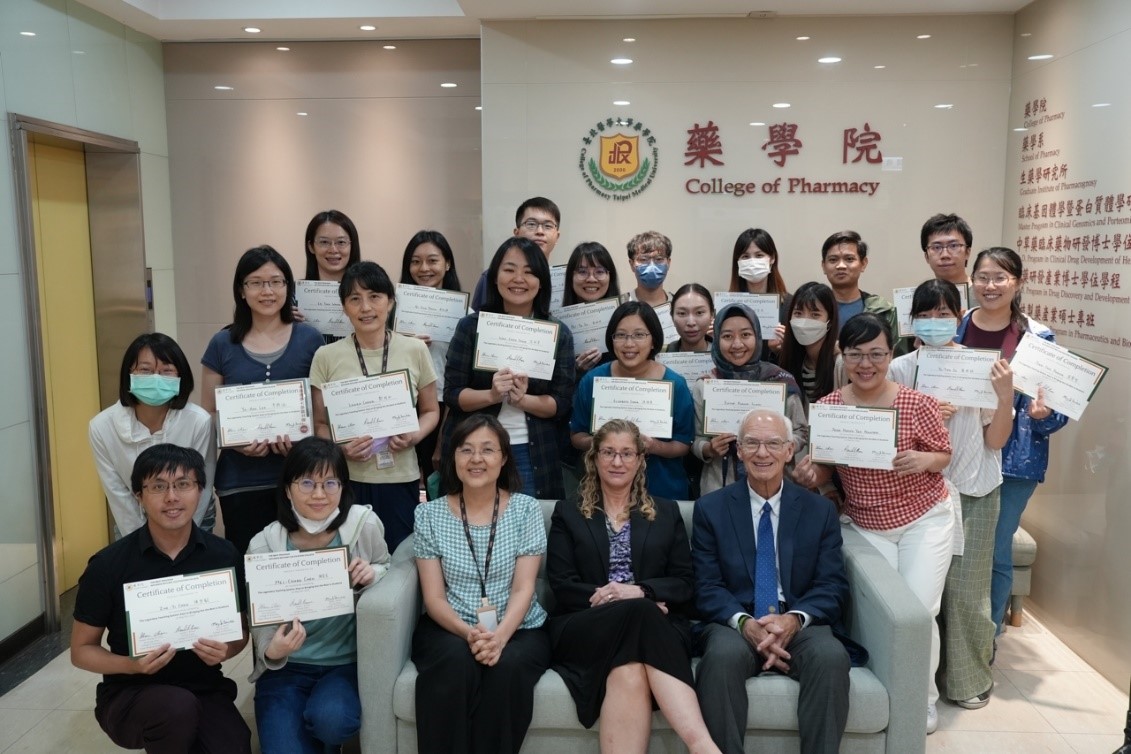
- The undergraduate program introduces EMI Pharmaceutical Science and Clinical Pharmacy microprograms. Both English track and non-English track students are encouraged to take EMI courses. Upon completion of the EMI microprograms, students receive an EMI microprogram certificate, fostering a culture of professional English proficiency and EMI learning throughout the entire department.
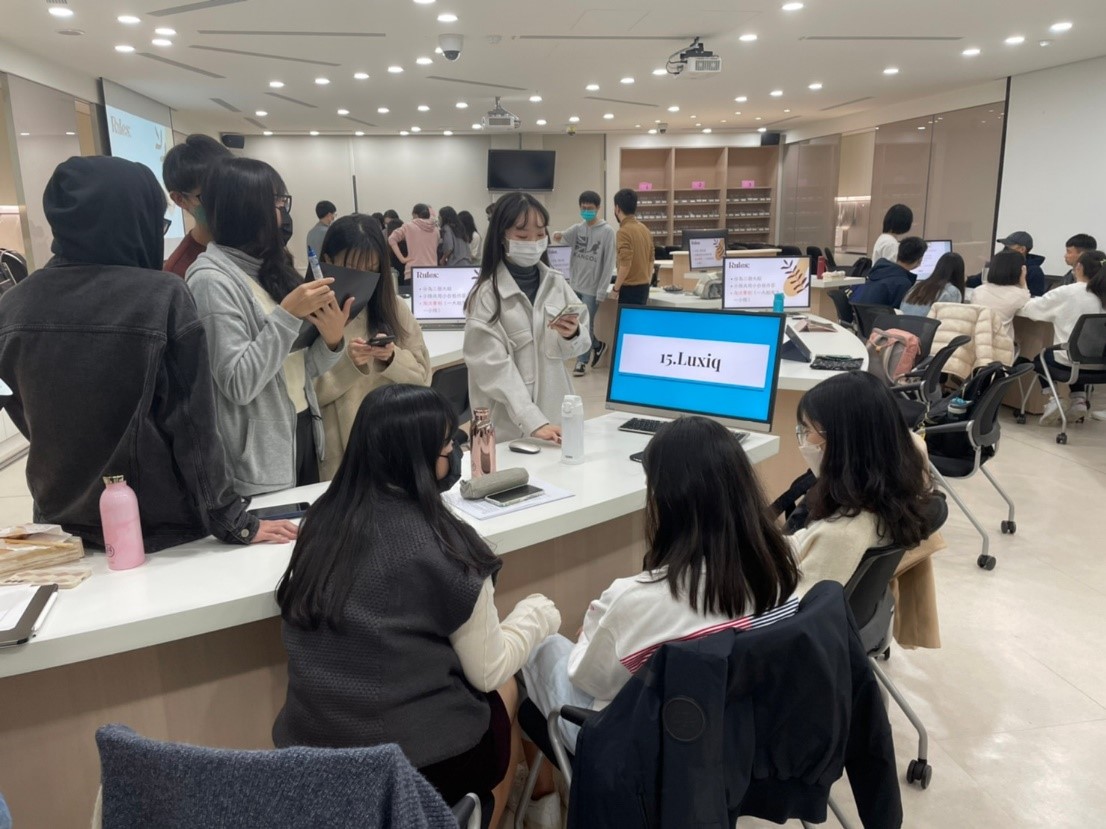
- EMI courses incorporate lively teaching models, such as group discussions, allowing students to enhance their professional knowledge and skills in both new drug development and clinical specialized pharmacy.
Empowering Students:
- Rewarding Basic English Proficiency:
- Through the Taipei Medical University School of Pharmacy's English proficiency incentive program, students are encouraged to enhance their English skills to achieve a CEFR B2 level in listening, speaking, reading, and writing.
- Providing Language Enhancement Resources:
- The university's Language Center offers one-on-one consultation services for "Basic English Conversation," "English Writing Skills," "Resume Revision," "Mock English Interview," and "English Presentation Practice." Additionally, TMU engLive digital teaching activities, utilizing platforms like Facebook or Google Classroom, promote interactive online activities such as "International Cultural Festival," "TMU eWriting Pal," "ACE cloud corner," "VR into Language Teaching," and "E-Learning Passport" to further enhance students' English proficiency using digital resources.
- Strengthening Academic English Proficiency:
- To reinforce the link between basic English and academic English, workshops on writing English experimental reports are conducted for incoming freshmen before they enter EMI laboratory courses. Workshops on scientific paper writing are also organized for upperclassmen and graduate students to enhance their proficiency in writing professional academic papers.
- Organizing Professional English Competitions:
- Pharmacy students were encouraged to host and organize extracurricular events. The Pharmacy Game Show was for freshmen and sophomores to deepen their understanding and knowledge of professional vocabulary. Sophomores and juniors also participate in workshops and competitions on English pharmacy education to establish an EMI learning atmosphere.
- Conducting Cross-Cultural Experience Activities:
- The International Office at Taipei Medical University organizes large-scale events like the International Cultural Expo, International Salon, International Food Festival, International Dance Night to promote mutual understanding and social integration between international and local students. The TMU I-Student Initiative encourages local and international students to form extracurricular learning teams, assisting international students in integrating into Taiwanese society and participating in campus club activities.
International Connections:
- Dual Degree Programs:
- The School of Pharmacy successfully signed dual degree agreements with excellent universities such as the University of Southern California School of Pharmacy (6+1 Master's-PhD dual degree), St. John's University in the United States (6+1 Master's-PhD dual degree), the University of Pennsylvania (6+1 Master's-PhD dual degree in Public Health), the American College of Traditional Chinese Medicine (Master's-Master's dual degree in Pharmacognosy), and the University of Cagliari in Italy (Doctoral-Doctoral dual degree in Herbal Clinical Drug Development). Students can access partner universities' courses through physical attendance or remote connections, facilitating a smooth international transition for School of Pharmacy students.
- International Summer Programs:
- During the summer break, collaborative summer programs are conducted with various overseas partner universities, allowing TMU students to learn alongside students from different countries.
- Overseas Internships and International Research Experiences:
- Each year, students are recommended for international experiences at top university hospitals or laboratories, such as the University of Southern California, the University of Illinois at Chicago, the University of British Columbia, the University of Iowa, and the State University of New York at Buffalo, providing opportunities for international exposure and research experiences.