National Central University-College of Engineering
Since the 2022–2023 academic year, National Central University (NCU) has been proactively advancing its English-Medium Instruction (EMI) initiatives, despite only the College of Engineering receiving MOE funding. Rather than confining EMI to a single college, NCU has strategically integrated resources at the university level through the NCU Bilingual Education Center and implemented a “top-down and bottom-up” approach to ensure that EMI policies reach across multiple colleges, including the College of Science, School of Management, College of Electrical Engineering and Computer Science, College of Earth Sciences, and the College of Health Sciences and Technology. Monthly meetings chaired by the Vice President facilitate coordination of progress and key performance indicators, while each college retains autonomy to develop suitable EMI strategies and incentive measures based on its disciplinary strengths and student needs.
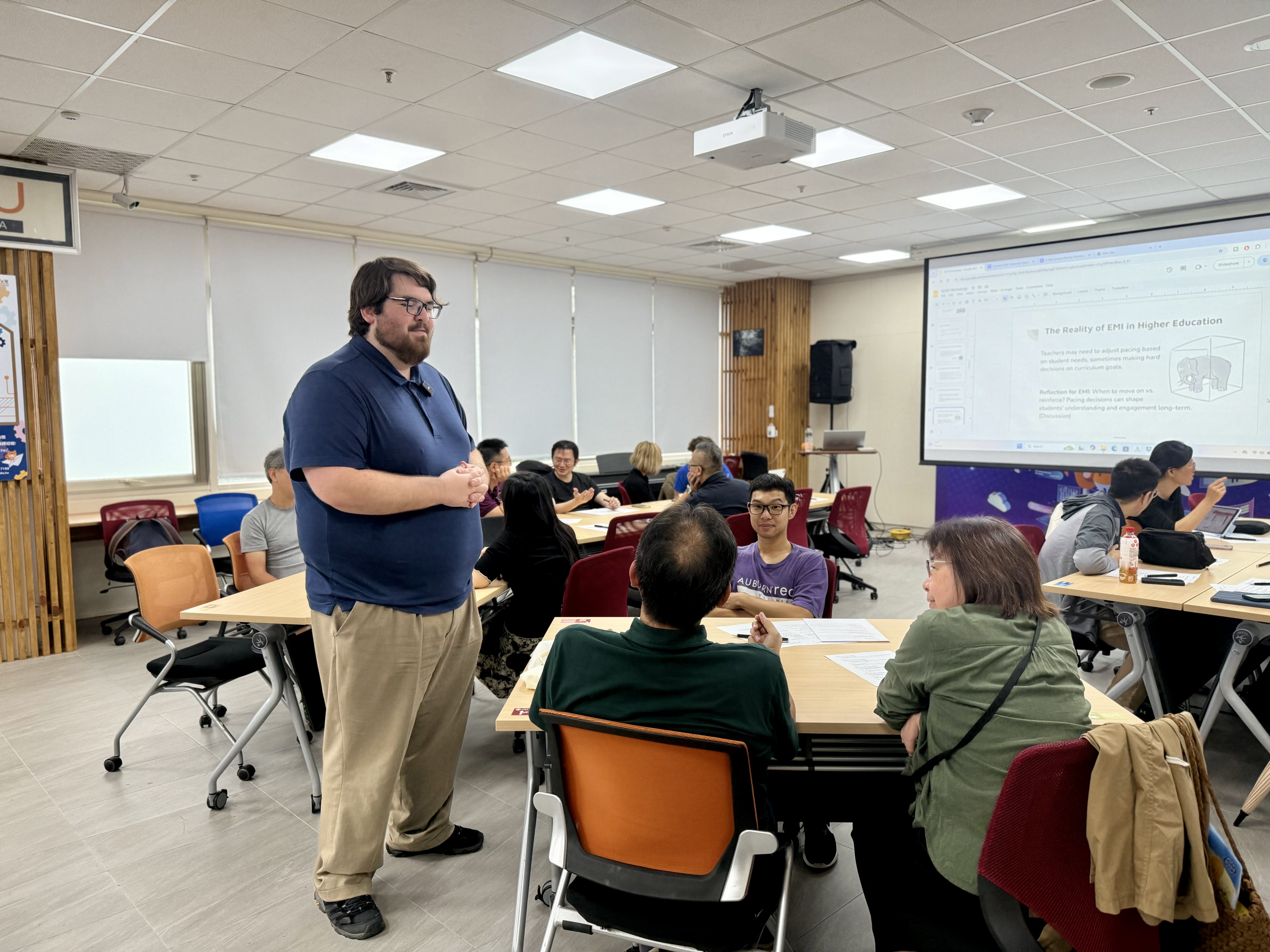
A key aspect of NCU’s EMI policy has been to synchronize EMI development with EAP (English for Academic Purposes) and ESP (English for Specific Purposes) courses. By identifying common teaching challenges, the Bilingual Education Center collaborates with academic departments to design bridging courses that strengthen students’ language skills before transitioning into EMI curricula. In the 2022–2023 academic year, a dedicated “EMI–EAP/ESP Collaboration” community was established, enabling experts from language and subject-based faculties to share best practices and co-design learning materials. Additionally, NCU has partnered with Fulbright Taiwan to conduct monthly faculty workshops focusing on EMI pedagogy, cross-cultural communication, and course design. Further, 18 faculty members have participated in overseas professional teacher training workshops, returning as “seed teachers” to foster a sustainable cycle of teacher development.
The College of Engineering, which leads in MOE-supported EMI efforts, demonstrates robust outcomes through a well-structured “college-level bilingual committee,” frequent consultation with the Bilingual Education Center, and well-defined incentives. In the 2022–2023 academic year alone, the College of Engineering offered 121 EMI courses and achieved a participation rate exceeding 20% for both sophomores and first-year graduate students. Supporting this progress is a variety of measures, including additional stipends for EMI instructors, dedicated teaching assistants, and access to specialized workshops or Classroom Observation sessions. The college also enhances students’ English skills by organizing language competitions, funding “bilingual self-study groups,” and providing supplementary conversation and writing sessions.
Overall, NCU’s EMI push has yielded promising results. From 2022 to 2023, the number of EMI-related workshops grew to 14, engaging 266 faculty members (a 125% increase from the previous year). The university provided 746 EMI courses (with 14,694 enrollments) and expanded EAP/ESP offerings, raising student English support from 297 to 556 participants—an 87% jump. Over 70% of students surveyed believe EMI courses strengthen both discipline-specific knowledge and English proficiency for future career or postgraduate pursuits. As NCU continues to refine its organizational structure, promote cross-college collaboration, and leverage global resources, the university aims to become a “benchmark for bilingual education,” cultivating well-rounded professionals ready to excel in an increasingly international society.