I-Shou University-College of Medicine
With the support of the Program on Bilingual Education for Students in College (“BEST Program”), outstanding EMI teaching staff, a diverse range of EMI courses, and an immersive English-language learning environment, colleges within the fields of “Social Science” and “Biology and Medical and Agricultural Science” (“colleges in the Two Fields”) have developed a comprehensive plan for a bilingual campus and bilingual education from the perspectives of students and learning, teachers and teaching, and supportive measures. The key achievements and highlights of the colleges related to the fields of “Biology and Medical and Agricultural Science” in Academic Year 2024 are as follows:
I. Improvement in Students’ English Proficiency Levels
(1) EAP/ESP-based English Courses
a. Freshman- and sophomore-level general English courses are organized into classes according to students’ English proficiency levels, utilizing course designs for EAP (English for Academic Purposes) and EGSP (Elementary General Specific Purposes). The proportion of English used as the medium of instruction gradually increases every year, in alignment with students’ improving language proficiency. The teaching methods for general English courses have been adapted to incorporate CLIL (Content and Language Integrated Learning). These courses also combine “intensive learning” and “extensive learning” approaches, allowing students to overcome time and space limitations and make use of online self-learning resource platforms to enhance the effectiveness of their English learning.

b. To support students in smoothly transitioning to EMI courses within their departments, colleges in the Two Fields have offered a total of 31 EAP/ESP courses, of which 14 are in the field of “Biology and Medical and Agricultural Science”. Furthermore, to foster students’ interest in learning professional English and strengthen their workplace English communication skills, 16 ESP seminars were conducted across five areas: advertising, workplace, job seeking, technology, and hospitality. A total of 125 students participated in these seminars.
(2) Establishment of the English Writing Center
In Academic Year 2023, ISU established the English Writing Center to provide English writing guidance and consultation services for all faculty members and students. In Academic Year 2024, the Center has held regular English writing workshops on both campuses. These workshops cover short essay writing and introductory academic writing techniques for undergraduate students, while those for graduate students focus on academic paper structure and literature search strategies. A total of 87 faculty members and students participated in the workshops. Additionally, in response to the growing influence of AI, workshops were conducted for faculty members on utilizing ChatGPT as a tool to support EMI teaching. To provide effective personalized support, a one-on-one English consultation group was established by general English course instructors in collaboration with ISU’s visiting specialist. The group offers scheduled weekly English writing consultations for faculty and students at designated locations on campus. In total, 299 faculty members and students made use of these services.

(3) EMI Course Innovation and Quality Assurance Mechanism
a. Comprehensive EMI professional courses: EMI professional courses at the basic, intermediate, and advanced levels are offered to freshman, sophomore, junior, and senior students, respectively, enabling students to continuously improve their English proficiency while developing subject-specific knowledge and skills. In Academic Year 2024, ISU offered a total of 436 EMI courses, representing 11.67% of all courses. Of these, 46 in the field of “Biology and Medical and Agricultural Science” (4%).
b. In line with ISU’s policy on offering innovative courses, colleges in the Two Fields have launched 15 interdisciplinary EMI micro-credit programs, including International Nursing, Health Communication, Medical Imaging and Tissue Engineering, Cell Therapy Technologies and other programs. A total of 313 students enrolled in these programs in Academic Year 2024, a significant increase from 215 enrollments in Academic Year 2023.
c. Assurance of Learning (AOL) and Assurance of Teaching (AOT) for EMI Courses. A teaching survey has been specially designed for EMI courses as part of the Assessment of Learning (AOL) framework. According to the final teaching survey results in Academic Year 2024, the average student satisfaction score in the field of “Biology and Medical and Agricultural Science” scored 16.15, compared with the university-wide average of 15.84. As part of the AOT process, course instructors were asked to reflect on students’ learning outcomes and propose improvement measures, if applicable. The field of “Biology and Medical and Agricultural Science” reported a response rate of 89%. Moreover, the quantitative and qualitative results of the AOL and the AOT were presented at meetings of the Curriculum Committees for in-depth discussion and the development of improvement strategies aimed at enhancing teaching and learning effectiveness.
(4) EMI Teaching Assistant Training
To equip EMI teaching assistants with the skills needed to support EMI course instructors and enhance students’ English proficiency, ISU offers specialized training designed by the visiting specialist. Students who complete the training with perfect attendance will receive a certificate, which qualifies them for higher wages if they apply to serve as EMI teaching assistants. In Academic Year 2024, a total of 4 EMI teaching assistant training sessions were held, with 142 participants. During the same academic year, 64 students served as EMI teaching assistants for 95 courses.

(5) Diverse English Learning Opportunities and On-campus English Proficiency Tests
a. To help course instructors track student progress and learning outcomes and to facilitate timely adjustments to teaching methods and materials, online English proficiency tests are used as pre- and post-assessments in freshman- and sophomore-level general English courses.
b. To assess students’ English learning outcomes and develop improvement plans accordingly, 8 English proficiency tests were held on campus. Regulations have been put in place to incentivize students to take these tests, with the aim of encouraging greater participation and enhancing their competitiveness. To actively promote the “BESTEP” (BEST Test of English Proficiency) test, developed by the Language Training & Testing Center (LTTC) under the commission of the Ministry of Education, relevant internal regulations were amended in Academic Year 2023 and formally implemented in Academic Year 2024. The BESTEP test has now been incorporated into the graduation requirements, the Regulations for Rewarding Students of I-Shou University for Passing Foreign Language Proficiency Tests, and the criteria for exemption from general English courses, all aimed at increasing student motivation to take the test. Among all students taking English proficiency tests, the percentage achieving CEFR Level B2 or above increased from 6% to 6.2%.
c. The field of “Biology and Medical and Agricultural Science” created online materials for 5 EMI courses, offering students English learning opportunities that are not limited by location or time. Additionally, to encourage student participation in various English learning activities on campus, the College of Medicine and the College of Medical Science and Technology have teamed up to implement the Autonomous Learning: English Boost Program. Students who participate in English learning activities or competitions organized by ISU or the College of Medicine can earn 1-2 credits for autonomous learning courses.
d. To encourage students to enroll in EMI courses, the field of “Biology and Medical and Agricultural Science” has adopted the Guidelines on Points-based Incentives for Students Taking EMI Courses at College of Medicine of I-Shou University, established in Academic Year 2023. Students who earn a certain number of credits from EMI courses are eligible to apply for incentive points. In Academic Year 2024, a total of 3 students of the College of Medicine (2 from the Department of Healthcare Administration and 1 from the Department of Nutrition) received incentive points.
(6) Diverse Immersive Activities
In Academic Year 2024, a wide range of English immersion activities were offered to students, providing opportunities to continue developing their English communication skills beyond regular class hours. These activities included:
a. Several university-wide activities were organized to provide students with immersive English learning experiences beyond the classroom. For example, “English Corner” covered different topics every week, giving participating students opportunities to practice and improve their English listening and speaking skills, while also building confidence in making presentations in English. The ISU Talent Show offered a stage for students to showcase their English abilities through singing, poetry recitation, storytelling, stand-up comedy, and public speaking. “LOHAS English Exchange Workshops” focused on life-oriented topics, such as tea tasting, floral appreciation, qigong, and wine appreciation, helping participating students hone their English communication skills. Additionally, to foster cross-cultural exchanges and create a mini-global village on campus, ISU organized the ISU Cultural Festival, the FiGE (Foundations in Global Engagement) program, the selection of cultural ambassadors, trips for exploring local cultures, etc., to help both domestic and international students experience different cultures and broaden their perspectives.

b. Colleges in the Field also organized their own engaging English learning activities. The College of Medicine and the College of Medical Science and Technology collaborated to host an English short film competition, an English presentation competition, and an English fun competition, providing opportunities for faculty and student interaction across the two colleges.

II. Enhancement of Faculty Members' EMI Skills
(1) Professional EMI Training
a. To support faculty EMI training, ISU invited a specialist from Canada, who offers both face-to-face and online EMI training courses. Additionally, EMI conversation courses were launched in Academic Year 2022 to help faculty members enhance their English communication skills. By Academic Year 2024, a total of 186 faculty members completed EMI training courses offered by ISU, including 100 from colleges in the Two Fields.
b. To enhance faculty members’ EMI skills and improve teaching quality and effectiveness, all colleges have formed faculty professional communities focused on EMI education. In Academic Year 2024, 29 on-campus EMI workshops and one-on-one EMI consultation sessions were conducted. To further support EMI teaching practice, peer observation was arranged, during which the visiting specialist observed 7 faculty members and provided feedback and suggestions. At the College of Medicine, faculty members were invited to observe the EMI courses delivered by their peers at the International College and to share their reflections and feedback.

c. Our faculty members have actively participated in inter-university EMI faculty learning communities formed by the Southern Regional Resource Center for Bilingual Education since its establishment. To date, our faculty members have established 3 inter-university faculty learning communities, and 18 faculty members have taken part in the related activities. In Academic Year 2023, one of our faculty members completed EMI training at Arizona State University in the U.S., organized by the Southern Regional Resource Center for Bilingual Education. Following the training, she shared her experiences and insights during inter-university faculty learning communities and on-campus EMI workshops,
attended by 16 ISU faculty members. Additionally, as a member of the Southern Regional Resource Center for Bilingual Education, ISU regularly participates in exchange meetings to foster collaboration and share best practices with universities and colleges in southern Taiwan.
III. Comprehensive Supportive Measures
(1) Information to Stakeholders and Friendly Communication
In addition to the information about the BEST Program on its website, the Bilingual Education and EMI Center regularly shares ISU news in English through a dedicated Facebook fan page and Instagram account. Colleges in the field have also created their own webpages focused on EMI education and the BEST Program. Colleges in the field also organized teacher-student forums, respectively, to gather students’ feedback for future improvements. Additionally, external EMI experts were invited to share their experiences with faculty members and students, further enriching the EMI teaching and learning environment. To objectively evaluate the implementation of the BEST Program, colleges in the field invited external experts for on-site visits. During these visits, the experts provided valuable feedback and suggestions, serving as an important reference for future improvements and continued implementation.

(2) Resource Sharing and Inter-Institutional Collaboration
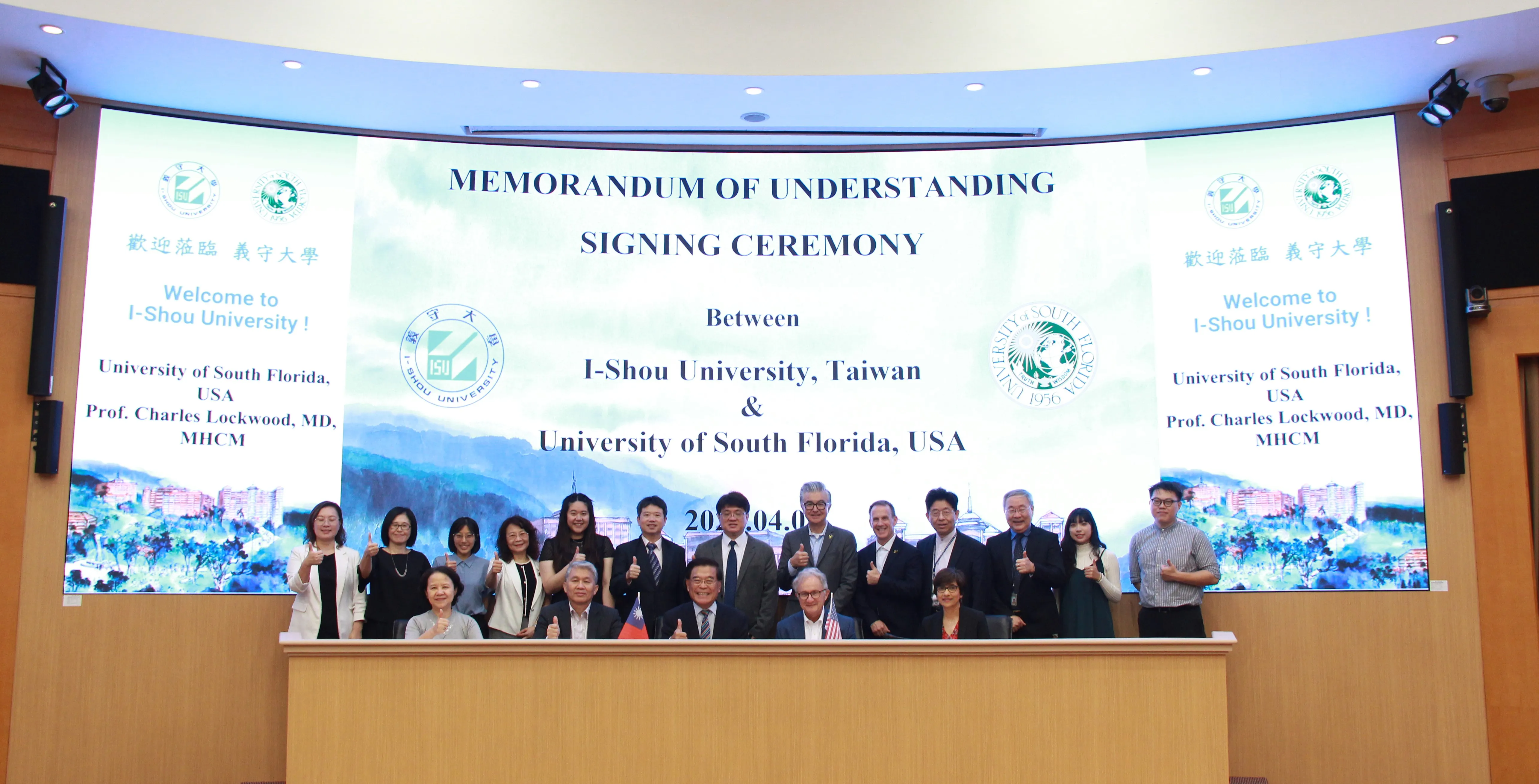
a. To foster an EMI resource-sharing platform with other universities and colleges in southern Taiwan, the College of Medicine has signed an agreement on course resource sharing and inter-university collaboration with National Kaohsiung Normal University and the College of Medicine of Kaohsiung Medical University, respectively. During Academic Year 2024, the College of Medicine continued its collaboration and exchanges with these partner institutions, organizing 2 faculty community activities and exchange meetings.
b. Hands-Together - Exchanges between International Students and Local Senior High School Students: ISU actively encourages and supports international students in engaging with local senior high school students. This initiative serves two main purposes: first, to help local senior high school students broaden their global perspectives and strengthen their international mobility; and second, to promote international students’ participation in service-learning activities that contribute to the community while deepening their understanding of local society and culture. In Academic Year 2024, a total of 56 international students visited local senior high schools, and 19 exchange seminars were conducted.
c. Bilingual Digital Learning Program: In collaboration with elementary and junior high schools in remote or indigenous areas, ISU students engage in meaningful exchanges and interactions to support after-school programs and assist local children in learning English. In Academic Year 2024, local and international students from colleges in the Two Fields provided online English tutoring and learning support to children in need from several remote elementary and junior high schools.
d. To help students of partner senior high schools enhance their English proficiency, ISU organized “ISPEAK,” an English learning achievement presentation and competition. This event encouraged senior high school students to actively engage in self-directed learning by thoroughly documenting their learning process and reflecting on their experiences, with the aim of fostering independent inquiry and lifelong learning skills. ISU faculty members and external experts served as judges, providing participants with concrete suggestions and feedback on their English presentations and project-based work. A total of 115 senior high school students took part in this event.

(3) Bilingual Education for Staff Members
To promote a bilingual campus culture, ISU offers English training courses tailored to staff members’ professional needs and proficiency levels. In Academic Year 2024, 71 staff members participated in these courses, receiving training in English speaking, listening, and writing to enhance their overall language skills.