National Taipei University of Business
National Taipei University of Business (NTUB), the first business university in Taiwan, has maintained a century-long tradition of practical and hands-on technical and vocational education. The university is committed to offering students the highest quality education in business management, establishing itself as a leading higher education institution in the field of business within the technical and vocational system. In response to the rapid changes in higher education, the growth of global innovation industries, the digital economy, and the need for cross-disciplinary learning, NTUB has adopted the Ministry of Education’s Program on Bilingual Education. It aims to cultivate students with international perspectives and global competitiveness while actively promoting campus internationalization and increasing its presence in global higher education. For the 2024 academic year, NTUB is implementing the Program on Bilingual Education for Students in College (BEST), focusing on five key areas: curriculum, students, faculty, teaching resources, and administration—creating a bilingual campus environment. Through these initiatives, the university continuously improves students’ English skills, with the ultimate goal of enhancing both their language abilities and employability.
Curriculum: NTUB has established a comprehensive system for developing EMI (English as a Medium of Instruction) courses. In the 2024 academic year, 51 EMI courses were offered. At the policy level, the university continues to review and refine the “Regulations on All-English Instruction.” Beyond regular teaching evaluations, NTUB piloted a quality assurance process for EMI learning outcomes in the spring 2025 semester. For first-year students, the university implements an English placement system, administers English proficiency tests, and focuses on improving speaking and writing skills. A multi-assessment framework has been developed to recognize external, credible English proficiency indicators such as TOEIC and the General English Proficiency Test (GEPT), alongside internal English proficiency exams. Language-learning activities are structured in three levels: the “point” (enhancing English skills), the “line” (enriching professional knowledge), and the “plane” (cultivating an international outlook and global competitiveness). This framework enhances students’ overall learning experience and ensures they are well-prepared for bilingual coursework.
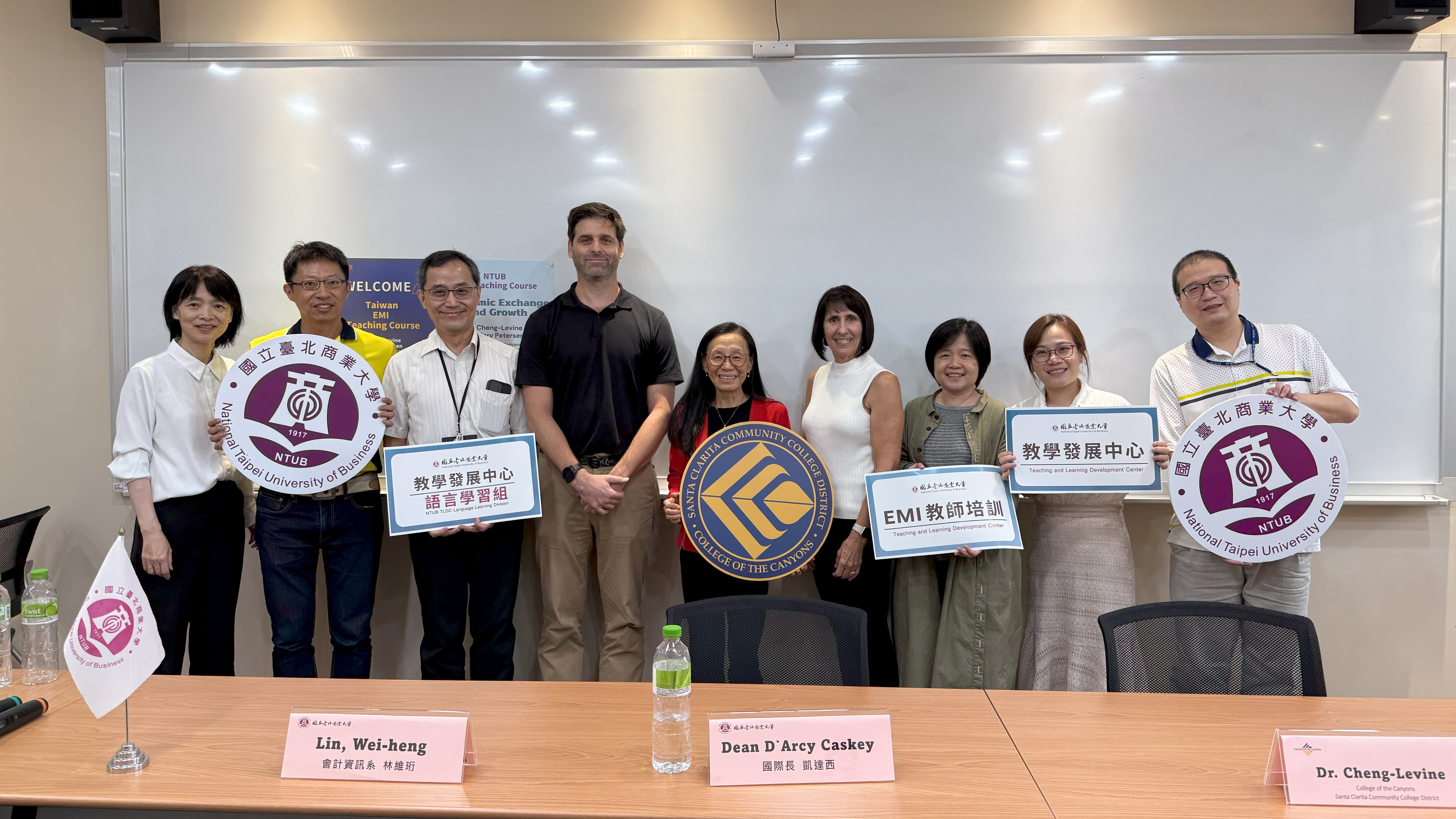
NTUB has developed the “EMI Faculty Professional Development Community," hosting two faculty training seminars, a reading group and lecture, an inter-university teaching exchange forum, and a classroom observation session. Additionally, the university received support from the EMI Teaching Resource Center at Taiwan Tech to conduct six more training workshops. NTUB also trained 15 EMI teaching assistants who enhanced their English skills, teaching techniques, and communication abilities, empowering them to effectively support faculty instruction.
Teaching Resources: NTUB launched the MyET English Speaking Practice software in the 2023 academic year. Usage increased greatly in 2024, with 5,377 total student logins, showing active student participation in digital oral practice.
Administrative Support – Building a Bilingual Campus: In pursuit of its vision to develop bilingual talents with international mobility and global perspectives, NTUB established the Bilingual Learning Promotion Committee. Meeting once each semester, the committee includes senior university administrators and two external experts. Its goal is to promote cooperation between administrative and academic units, integrate external expertise, and improve the effectiveness of bilingual initiatives. To ensure transparency and communication, meeting minutes are published online for the entire campus community.
To better serve international faculty, students, and partner institutions, NTUB has gradually bilingualized its administrative and academic webpages, regulations, and forms, enhancing accessibility and transparency of information. Additionally, the university has systematically reviewed and updated bilingual building directories and signage across campus, fostering a welcoming and user-friendly bilingual learning environment.