Chung Hua University-College of Tourism
Chung Hua University has long been distinguished by its commitment to quality teaching, international engagement, and strong industry collaboration. In response to the Ministry of Education’s Bilingual Education for Students in College (BEST) Program, the University has designated the College of Tourism as its key cultivation college and integrated the resources of the university-level Language Center and the college-level EMI Center to establish a comprehensive and sustainable bilingual education model. Adopting a “Whole University” approach, the University engages all stakeholders, including senior administrators, academic units, faculty members, and students, in the promotion of bilingual education. By incorporating bilingual education into its medium- and long-term institutional development plans as well as the Higher Education Sprout Project, Chung Hua University has systematically developed a complete learning pathway from English for General Purposes (EGP), English for Academic Purposes (EAP), and English for Specific Purposes (ESP) to English as a Medium of Instruction (EMI). Through this integrated framework, students are equipped with professional knowledge, English communication skills, and international mobility competencies, enhancing their future employability in the global workforce.
In terms of student learning, Chung Hua University has developed a distinctive tiered and differentiated English curriculum. First-year students are placed into either Advanced or Practical English tracks based on their language proficiency. The Advanced track focuses on academic writing development through digital learning platforms and data-driven personalized feedback, while the Practical track incorporates Virtual Reality (VR)-based immersive learning environments to strengthen students’ oral communication and real-world interaction skills. In Academic Year 2024–2025, students demonstrated improvement rates exceeding 50% in English writing, speaking, listening, and reading assessments, indicating the effectiveness of the University’s innovative teaching approaches. During the second year, discipline-specific English courses are offered according to students’ academic backgrounds, including Tourism English, Technology English, Business English, Intercultural Communication, and English Presentation Skills. By integrating language learning with professional content, students achieved a 53.9% improvement in professional English vocabulary acquisition, significantly enhancing their ability to apply English within their respective fields.
Regarding EMI implementation, Chung Hua University continues to expand both the quality and quantity of EMI courses. In Academic Year 2024–2025, the University offered 59 EMI courses, surpassing the Ministry of Education’s target of 52 courses. These courses span diverse disciplines, including tourism, hospitality, MICE (Meetings, Incentives, Conferences, and Exhibitions), and business management. Guided by the philosophy of “Learning by Doing,” EMI courses integrate industry practice, international exchange, overseas study visits, and project-based learning, enabling students to acquire professional knowledge through authentic English-language learning experiences. In addition, the University has established an EMI Teaching Assistant (EMI TA) training program to support classroom instruction and student learning. This initiative fosters an inclusive and supportive bilingual learning environment where EMI serves not only as a medium of instruction but also as a platform for cultivating intercultural communication skills and global perspectives.
Faculty professional development is another key highlight of Chung Hua University’s bilingual education initiative. The College of Tourism established a dedicated EMI Center and has maintained a long-term partnership with Trinity College London (TCL). In 2023, the College was officially recognized as a Trinity College London EMI Teaching Resource Center, making it one of the few universities in Taiwan qualified to provide internationally recognized EMI teacher training. The University regularly organizes internationally accredited EMI workshops, peer observation activities, faculty learning communities, and mentoring programs to strengthen instructors’ EMI teaching competencies. By the end of Academic Year 2024–2025, eight faculty members had obtained the internationally recognized CertPT certification, while four had advanced to become certified Teacher Trainers capable of training other EMI educators. Furthermore, Chung Hua University actively collaborates with international professional organizations, including Oxford EMI, to introduce the latest EMI pedagogical concepts and practices, thereby establishing a faculty development system aligned with international standards.
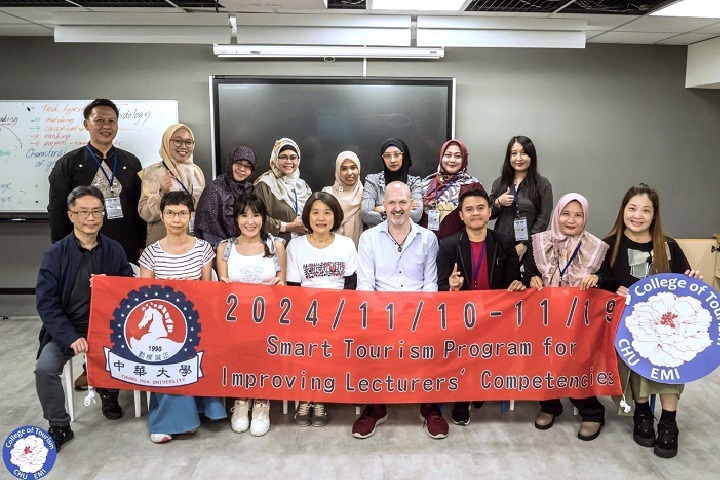
International collaboration and brand development constitute another important pillar of Chung Hua University’s bilingual education strategy. In addition to operating a dual-degree program with the University of Sunderland in the United Kingdom, the University maintains long-standing partnerships with the Asia Pacific Institute of Event Management (APIEM), institutions in Canada, and universities in the United Arab Emirates. The University regularly hosts English-medium ambassador lectures, international forums, and EMI conferences, providing valuable opportunities for interaction among students, scholars, and professionals from around the world. Notably, in 2024, Chung Hua University was selected by the Indonesian Ministry of Education as one of only two Taiwanese universities to host participants in the Elite University Faculty Development Program. Through its “Smart Tourism and EMI” training program, the University provided professional development opportunities for Indonesian university faculty members, demonstrating its leadership in EMI professional development and the international export of bilingual education expertise. In addition, Chung Hua University has partnered with National Tsing Hua University to organize international EMI conferences, attracting educators from Taiwan and abroad and gradually establishing a highly influential EMI brand within the higher education community.
Overall, Chung Hua University has successfully established a comprehensive bilingual education ecosystem characterized by five key strengths: student learning effectiveness, faculty professional development, international certification and training, industry-oriented practical learning, and international collaboration and exchange. Through institution-wide support mechanisms, internationally recognized teacher training systems, and curriculum design aligned with industry needs, the University has not only enhanced students’ English proficiency and international competitiveness but has also emerged as a leading benchmark institution for EMI implementation in Taiwan’s tourism, hospitality, and MICE education sectors. As such, Chung Hua University provides a concrete and exemplary model for advancing the goals of Taiwan’s Bilingual Nation 2030 policy.